
Clinton County Circuit Court Overview
Clinton County sits inside the 29th Judicial Circuit Court, a circuit shared with neighboring Gratiot County. In Michigan, the circuit court is the highest trial court at the county level. It handles felony criminal cases, civil suits with more than $25,000 in dispute, divorce and other family division matters, name changes, paternity, personal protection orders, juvenile cases, and appeals that come up from the district court.
Two elected judges rotate through the Clinton County side of the circuit on a set schedule. Because the circuit is shared, those judges also hear matters in Gratiot County, and the calendar in St. Johns reflects that split. The county clerk, not a separate court clerk, is the office that files and stores circuit court civil, criminal, and family records for public access.
Michigan does not use numbered trial courts the way some states do, so there is no list of separately numbered circuit courts inside the county. Instead, Clinton County residents deal with three trial-level courts in the same courthouse complex: the Circuit Court, the 65A District Court, and the Probate Court.
Trial Courts in Clinton County
All three trial courts share the county courthouse at 100 E State Street in St. Johns, each in its own suite. The Circuit Court hears the heaviest matters, the district court handles the high-volume everyday docket, and the Probate Court runs estate and guardianship work along with parts of the family and juvenile caseload. The table below maps each court to what it handles and how to reach it.
| Court | What It Handles | Suite / Address | Phone |
|---|---|---|---|
| Circuit Court (29th Judicial Circuit) | Felonies, civil over $25,000, divorce and family division, name change, paternity, PPOs, juvenile, appeals from district court | Suite 4500, 100 E State Street, St. Johns, MI 48879 | 989-224-5132 / 989-224-5130 |
| 65A District Court | Misdemeanors, felony preliminary exams, traffic, small claims, evictions, garnishments, civil up to $25,000 | Suite 3400, 100 E State Street, St. Johns, MI 48879 | 989-224-5155 |
| Probate Court | Estates, guardianships, conservatorships, wills, adoptions, juvenile and mental-health matters | 100 E State Street, St. Johns, MI 48879 | 989-224-5190 |
The prosecuting attorney's office and the indigent defense office also sit in the same building, in Suites 3100 and 1500. That keeps the felony pipeline, from charging through appointed counsel, inside one complex.
Circuit Court vs. District Court vs. Probate Court
The clearest way to understand where a Clinton County case belongs is to compare the three trial courts side by side. The dividing lines are the dollar amount in a civil case, whether the charge is a felony or a misdemeanor, and whether the matter involves an estate, a guardianship, or a juvenile. Circuit Court is the felony and higher-civil forum, the district court is the misdemeanor and lower-civil forum, and the Probate Court is the estate and protective-proceeding forum.
| Circuit Court | District Court | Probate Court | |
|---|---|---|---|
| Civil Limit | Over $25,000 | Up to $25,000 | Estate and asset value based |
| Criminal Jurisdiction | Felonies | Misdemeanors and preliminary exams | None (juvenile delinquency work) |
| Family / Divorce | Yes (family division) | No | Shares juvenile and guardianship matters |
| Estates & Guardianship | No | No | Yes |
| Appeals From | District Court | Magistrate rulings | N/A |
Note: A felony case starts in the district court for the first steps, then moves up to Circuit Court, so a single case can appear in two courts before it closes.
How a Case Moves Through the Clinton County System
A felony in Clinton County does not begin in Circuit Court. It starts with an arrest and a first appearance in the 65A District Court, where the charge is read and bond is set. The district court then holds a preliminary examination to decide whether there is enough evidence to send the case up. If the case is bound over, it lands in Circuit Court for arraignment and trial. This split is the single most common source of confusion for people searching for a case, because the early records live at the district level and the later records live at the circuit level.
Felony flow: Arrest › District Arraignment › Preliminary Exam › Bindover › Circuit Arraignment › Pretrial › Trial › Sentencing › Court of Appeals
Civil and family matters that exceed the district court threshold, along with divorces, are filed directly with the county clerk for the Circuit Court. From there they follow the familiar path of complaint, answer, discovery, motions, and either settlement or trial. A judgment entered in Circuit Court can be appealed to the Michigan Court of Appeals and, in rare cases, to the Michigan Supreme Court.
Circuit Judges and Motion Scheduling
Two judges cover the Clinton County side of the 29th Judicial Circuit. Judge Cori E. Barkman sits in Clinton County during the first and third weeks of each month, and Judge Shannon L.W. Schlegel sits during the second and fourth weeks. Knowing the weekly rotation helps when scheduling a hearing, because the assigned judge depends on the calendar.
Circuit motions are not scheduled through a court filing window. Instead, a party calls the assignment clerk to reserve a hearing date, then mails the motion and the notice of hearing to the county clerk's office. A copy of the papers goes to the judge's chambers. Praecipes are not required in this circuit, which simplifies the paperwork compared with some other Michigan courts.
The clerk's office prepares the sentencing commitments that send felons to jail or prison, and it sends abstracts of conviction to the Secretary of State for entry into the state law enforcement information network. That makes the clerk a working part of the criminal process, not just a records counter.
Searching Clinton County Circuit Court Records
Circuit court files in Clinton County are kept by the county clerk, and there is more than one way to reach them. The right channel depends on how old the case is and whether it has been digitized. Newer cases are the easiest to find online, while older paper files usually require a visit or a mailed request. The full set of court records, including dockets and case documents, is described in more depth on the Clinton County court records pages.
These are the main channels for looking up a circuit case:
- County clerk record search: the CaseLook portal at clintoncountycourts.org indexes clerk and court records by attorney, agency, judge, date range, and name.
- Circuit Court case inquiry: the county's Record Searches page links directly to circuit court case lookups.
- MiCOURT statewide search: the Michigan case search at micourt.courts.michigan.gov can surface civil, criminal, domestic, and probate cases depending on the court.
- In person: the clerk's office in Suite 2600 handles walk-in searches during business hours.
- By mail: a written request with a self-addressed stamped envelope and payment returns a name search, usually within 24 hours.
Fees track the record's age. Circuit cases filed after July 1996 can be searched online, in person, or by mail at a rate of $10 per name for a ten-year search. Cases before July 1996 can be searched in the office at no charge, or by mail for the same $10 per name. Copies of court documents run $2 per page for the first ten pages and $0.50 after that, with certified copies at $1 per page plus a $10 certification fee. Mail payments go by check or money order to the Clinton County Clerk. The Clinton County Clerk office publishes the full fee list.
The 65A District Court and Probate Court
The 65A District Court is the county's lower court and the busiest by case count. It handles adult misdemeanors, arraignments, bond, and sentencing, along with the preliminary exams that decide whether a felony moves up to Circuit Court. On the civil side it takes small claims, evictions, land-contract and mortgage foreclosures, garnishments, and general civil cases up to $25,000. The district court's judge is Hon. Andrew Stevens, and Magistrate Nicole Maneval handles many of the intake and small-claims matters. District court hours run Monday through Friday, 8 a.m. to 4:45 p.m., with civil filings closing at 4:30 p.m.
The Probate Court is a separate county court with its own judge, Lisa Sullivan, who also sits over the family division. Probate handles estates, trusts, guardianships, conservatorships, will safekeeping, adoptions, and mental-health commitments, plus parts of the juvenile docket that overlap with the circuit family division. Because family and juvenile work is split across the circuit and probate benches, a single family situation can touch more than one court.
Specialty Treatment Courts
Clinton County participates in two regional treatment courts that give eligible defendants a structured alternative to a standard sentence. Both run for 12 to 24 months across four phases and require treatment, drug testing, peer support, community service, case management, and regular review hearings. The Mid-Michigan Regional Mental Health Court, described on the Gratiot County mental health court page, serves Gratiot, Clinton, Montcalm, and Ionia Counties for felony and misdemeanor offenders who meet the criteria.
Judges Stewart D. McDonald, Andrew Stevens, Adam Eggleston, and Robert S. Sykes Jr. share the mental health court bench across the participating counties. Referrals come through an official form posted on the regional court site.
The Mid-Michigan Regional Sobriety Court is a drunk and drugged driving treatment court covering Gratiot, Clinton, and Montcalm Counties. Details on eligibility and the phase structure appear on the Gratiot County sobriety court page, and the program is guided by Judges McDonald, Stevens, and Eggleston.
Both courts treat participation as a demanding option rather than a lenient one, since the testing and hearing schedule is heavier than ordinary probation. The county also lists online ticket mediation, conviction set-aside help, and probation classes as related court services.
The Clinton County Courthouse
The courthouse that houses the Circuit Court has deep local history. The county seat moved from DeWitt to St. Johns in 1857, a small brick county building went up in 1858, and a larger courthouse begun in 1869 was finished in 1872. That earlier building served the county for roughly a century, even after its dome was struck by lightning in 1871. The county's historical resources page traces this record of continual reuse and adaptation.
The county has long emphasized courthouse continuity rather than starting over, folding older courthouse elements into newer ones. The present courthouse was dedicated on June 22, 2000, and its story is set out on the county's new courthouse page. At 117,000 square feet, the building brings the circuit court, district court, probate court, county clerk, and register of deeds together under one roof.
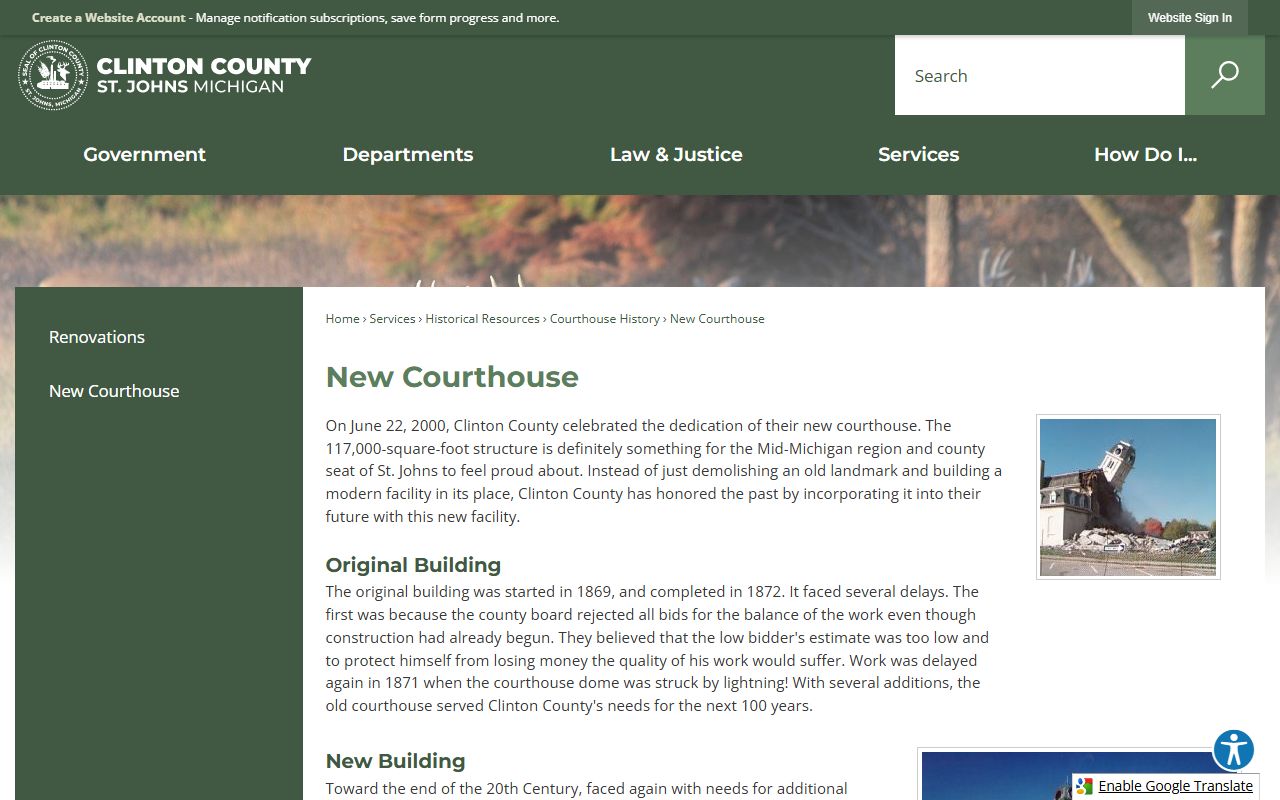
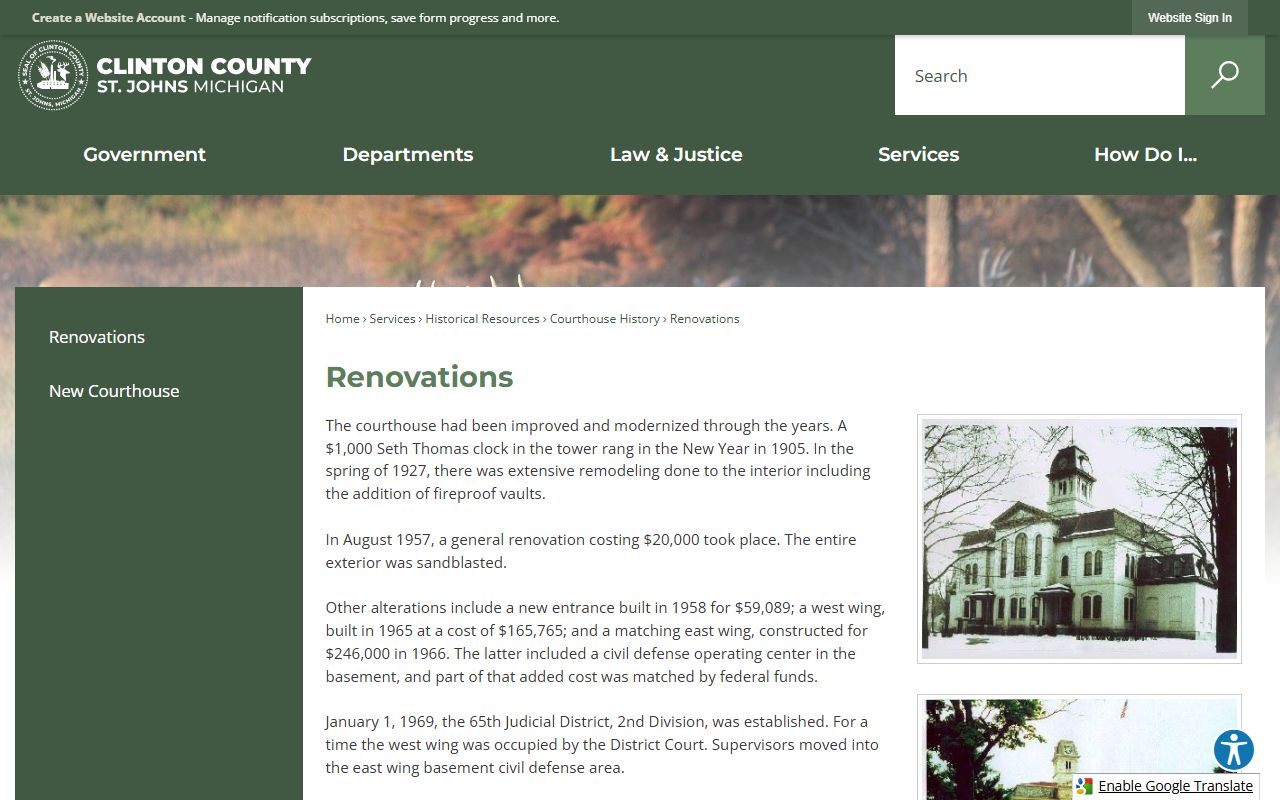
Earlier renovations reshaped the old courthouse layout across the late 1950s and 1960s, when judges chambers were added and the west wing served the district court for a time. Those changes are documented on the county's renovations page.
For readers tracking hearing dates and calendars rather than closed files, the county publishes court schedules that show when each judge sits, alongside the case calendars and docket listings the courts post online.