
How to Search Clinton County Court Records
Clinton County does not funnel every case into one master database. The county's own rule is simple: begin with the court level that holds the record, then pick the matching portal. Circuit Court cases run through the county clerk record search and the statewide MiCOURT case search. District Court matters use the district court case inquiry and the register of actions. Marriage, death, and assumed-name records live on the clerk's Tyler self-service site.
Before you start, gather a few basics. A full party name helps most searches, and the clerk's portal is built around name, attorney, agency, and judge fields rather than a single case-number box. A case number, a date range, or a driver's license number speeds up the district court and traffic tools. Older files may not be online at all.
- Decide which court owns the record: Circuit Court for felonies and family cases, the 65A District Court for traffic and misdemeanors, or Probate Court for estates.
- Open the matching portal, accept the disclaimer, and enter a party name or case number.
- Narrow the results by court, date range, or role such as attorney, agency, or judge.
- Review the docket entries, hearing dates, and disposition shown for the case.
- Request a certified copy from the clerk if you need a version accepted in court.
The county homepage links most of these tools in one place. A quick look at the Clinton County website shows how the record searches, court schedules, and payment links are grouped by department.
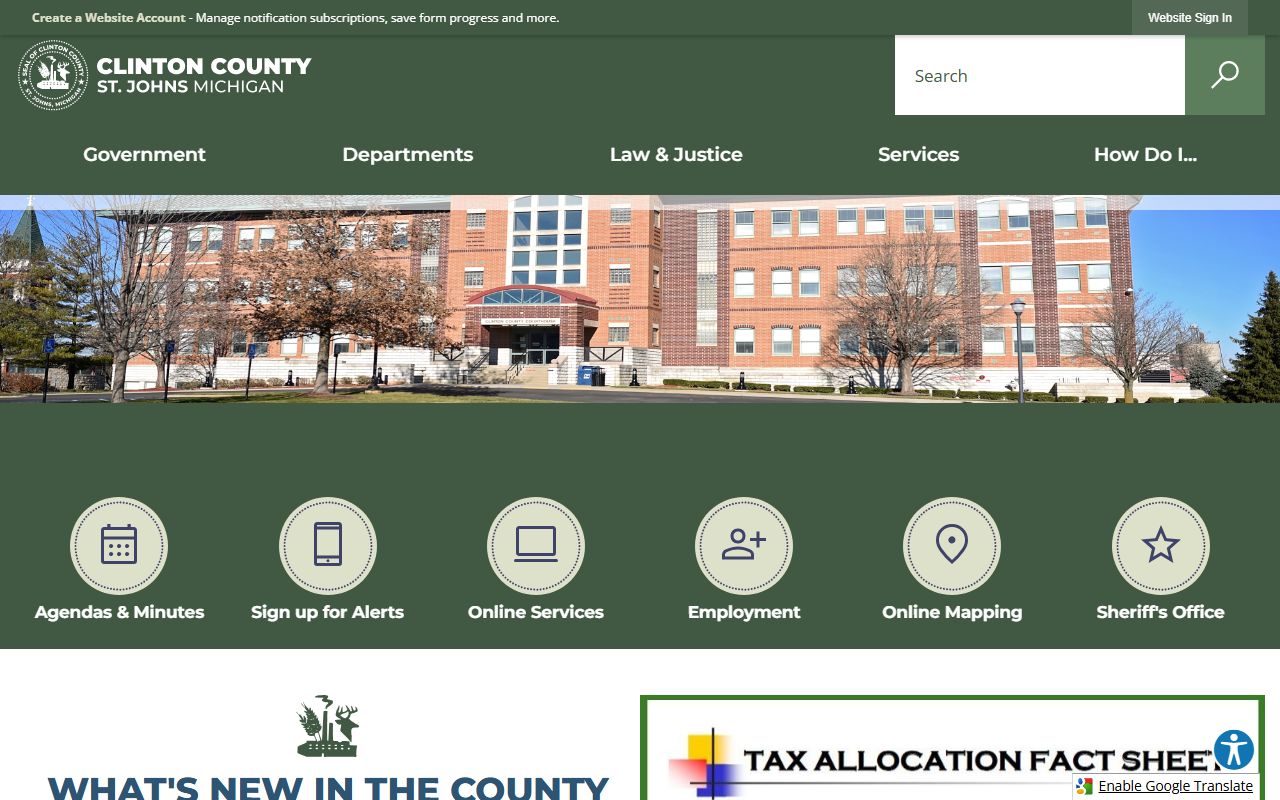
That single starting point saves time because the county keeps its record searches, docket links, and online payment tools tied to the office that actually holds each Clinton County court record.
The Clinton County Judicial System
Michigan uses a circuit-centered trial structure, and Clinton County follows it closely. The county shares the 29th Judicial Circuit Court with neighboring Gratiot County. The 65A District Court serves Clinton County as the lower trial court, and Probate Court stands as a separate county court. Appeals move up to the Michigan Court of Appeals and then the Michigan Supreme Court.
Two circuit judges rotate through St. Johns. Judge Cori E. Barkman sits in the first and third weeks of each month, and Judge Shannon L.W. Schlegel sits in the second and fourth weeks. The district court judge is Hon. Andrew Stevens, with Magistrate Nicole Maneval, and Probate Judge Lisa Sullivan is also assigned to the family division. The county's Law and Justice department page lists these courts and offices together.
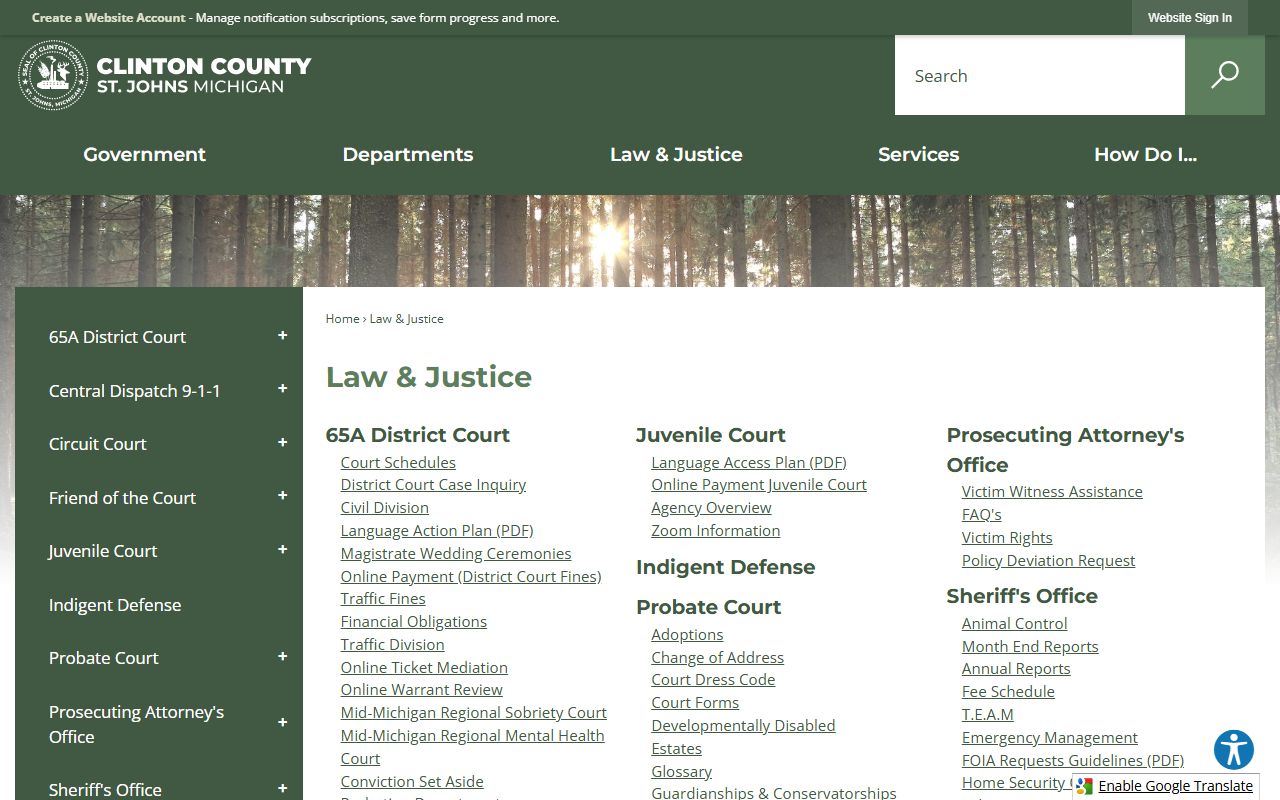
That page is the fastest way to see how the trial courts, clerk, prosecutor, and sheriff connect within one county court system.
Case flow: 65A District Court › 29th Circuit Court › Michigan Court of Appeals › Michigan Supreme Court
| Court | Jurisdiction | Case Types |
|---|---|---|
| Michigan Supreme Court | Statewide, highest court | Final appeals, rule-making |
| Michigan Court of Appeals | Statewide intermediate appeals | Appeals from circuit and district courts |
| 29th Circuit Court | Clinton and Gratiot Counties | Felonies, civil over $25,000, divorce, family, PPOs, juvenile |
| 65A District Court | Clinton County | Misdemeanors, traffic, small claims, evictions, civil up to $25,000 |
| Probate Court | Clinton County | Estates, guardianships, conservatorships, adoptions, mental health |
Comparing Clinton County Trial Courts
Readers often mix up the three trial courts because they share one building. The clearest way to keep them straight is by the money limit and the type of dispute each court hears. The Circuit Court is the higher civil and felony court, the District Court handles the everyday volume of traffic and small claims, and the Probate Court works entirely with estates, protected persons, and related family matters.
| Feature | Circuit Court | District Court | Probate Court |
|---|---|---|---|
| Civil dollar range | Over $25,000 | Up to $25,000 | Estate value based |
| Criminal cases | Felonies | Misdemeanors, felony exams | None |
| Family matters | Divorce, PPOs, paternity | None | Guardianship, adoption |
| Suite | 4500 | 3400 | Main courthouse |
| Phone | 989-224-5132 | 989-224-5155 | 989-224-5190 |
When a felony begins, it often starts in District Court for the preliminary exam, then binds over to Circuit Court. The county's Circuit Court page explains how motions and hearings are set through the assignment clerk.
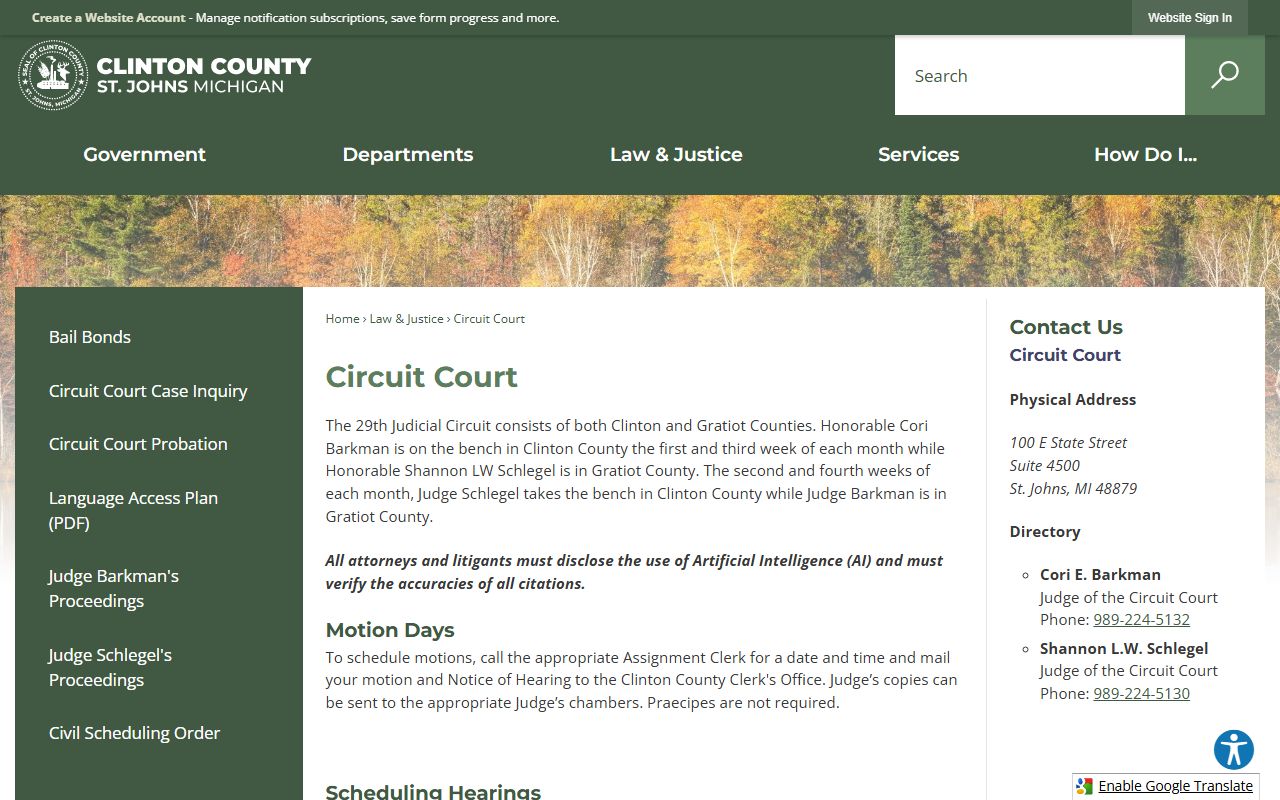
Knowing which court hears a matter tells you which portal and clerk suite to use for the underlying Clinton County court records.
Types of Court Records Available in Clinton County
Clinton County court records span the full range of civil, criminal, family, traffic, and probate matters. Which court produced the record tells you where the file lives. Circuit civil cases run over $25,000, while district civil cases stay at or below that line. Criminal files split between district misdemeanors and circuit felonies, and family cases sit in the circuit family division and the probate juvenile docket.
The county's 65A District Court handles the largest share of everyday filings, from traffic citations to landlord evictions. A visit to the 65A District Court page shows the case inquiry, court schedule, and payment tools tied to those records.
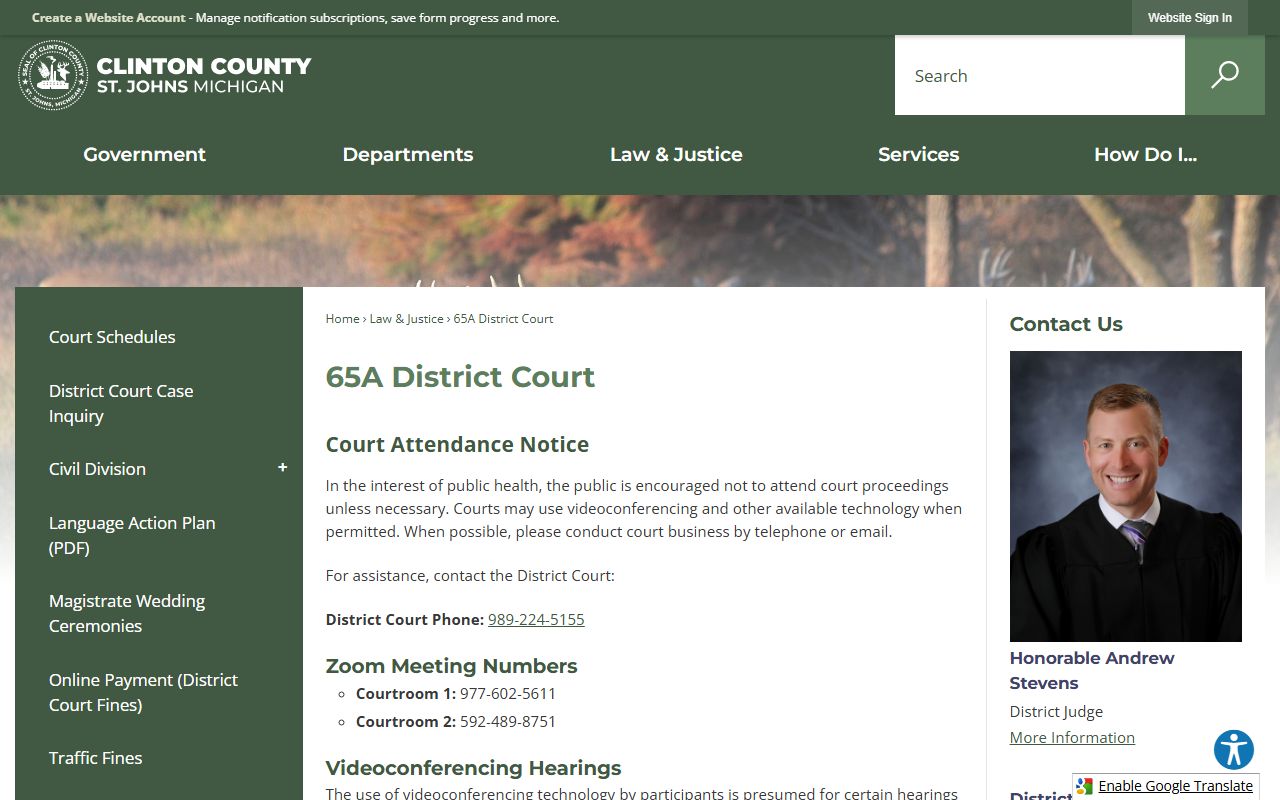
Because so many local matters route through the district court, that page is a common first stop for residents checking a citation or a small claim.
- Criminal records - felony files in Circuit Court and misdemeanor cases in District Court.
- Civil records - complaints, answers, motions, orders, and judgments split by dollar amount.
- Family and divorce records - divorce, paternity, name change, PPOs, and support cases.
- Probate records - estates, guardianships, conservatorships, and will safekeeping.
- Traffic records - citations and civil infractions handled through the district court route.
What Clinton County Court Records Show
A court record is more than a verdict. It is the full history of a case, built entry by entry as documents are filed and hearings are held. Michigan court files typically carry a case number, the case type, the assigned judge, party and attorney names, docket entries, hearing dates, the disposition, and any financial obligations. Status labels such as open, closed, disposed, transferred, sealed, or nonpublic tell you where the case stands.
The county has not published a single sample result page in the material captured for these portals, so the exact result grid is not shown here. The fields below reflect what Michigan court records normally contain and what the county's search tools ask for.
| Field | What It Shows |
|---|---|
| Case Number | The court's unique identifier for the file |
| Filing Date | When the case was opened with the clerk |
| Parties | Plaintiff, defendant, petitioner, or respondent names |
| Charges / Cause | The offense charged or the civil claim raised |
| Disposition | How the court resolved the matter |
| Sentence / Judgment | The penalty or final decision ordered |
Note: County portals can lag new filings by at least 24 hours, so a very recent case may not appear online right away.
Search Fields in the County Record Portal
The clerk's public record search, branded as CaseLook, is built around roles rather than a single case-number box. That design helps when a user knows a name but not a number. The linked search code shows fields for party name, attorney, agency, judge, and a beginning and ending date range. The portal clears other fields when one is selected, and it can auto-fill today's date for docket-style searches.
| Field | Type | Notes |
|---|---|---|
| Party name | Text | Try all spelling variations |
| Attorney name | Text or dropdown | Searches by counsel of record |
| Agency name | Text or dropdown | Filters by filing agency |
| Judge name | Dropdown | Filters by assigned judge |
| Beginning date | Day / month / year | Start of the search window |
| Ending date | Day / month / year | End of the search window |
The district court's Court Innovations portal uses a different field set for traffic and warrant review, asking for a driver's license number, license state, date of birth, or case number. It is an action tool, not just a lookup, and it can send status updates by email or text after an eligibility review.
Clinton County Courthouses
Nearly all of the county's judicial offices share one address at 100 E State Street in St. Johns, a 117,000-square-foot courthouse dedicated in 2000. The clerk, circuit court, district court, and probate court each occupy their own suite in the complex. The sheriff's office and jail sit apart on E Townsend Road.
County Clerk / Register of Deeds
100 E State Street, Suite 2600
St. Johns, MI 48879
989-224-5140
65A District Court
100 E State Street, Suite 3400
St. Johns, MI 48879
989-224-5155
The clerk's office keeps split hours, open Monday through Friday from 8 to noon and 1 to 5, closed over the lunch hour. Staff ask that visitors arrive by 4:30 p.m. for transactions. The county's County Clerk's Office page confirms these hours and lists the office's many duties.
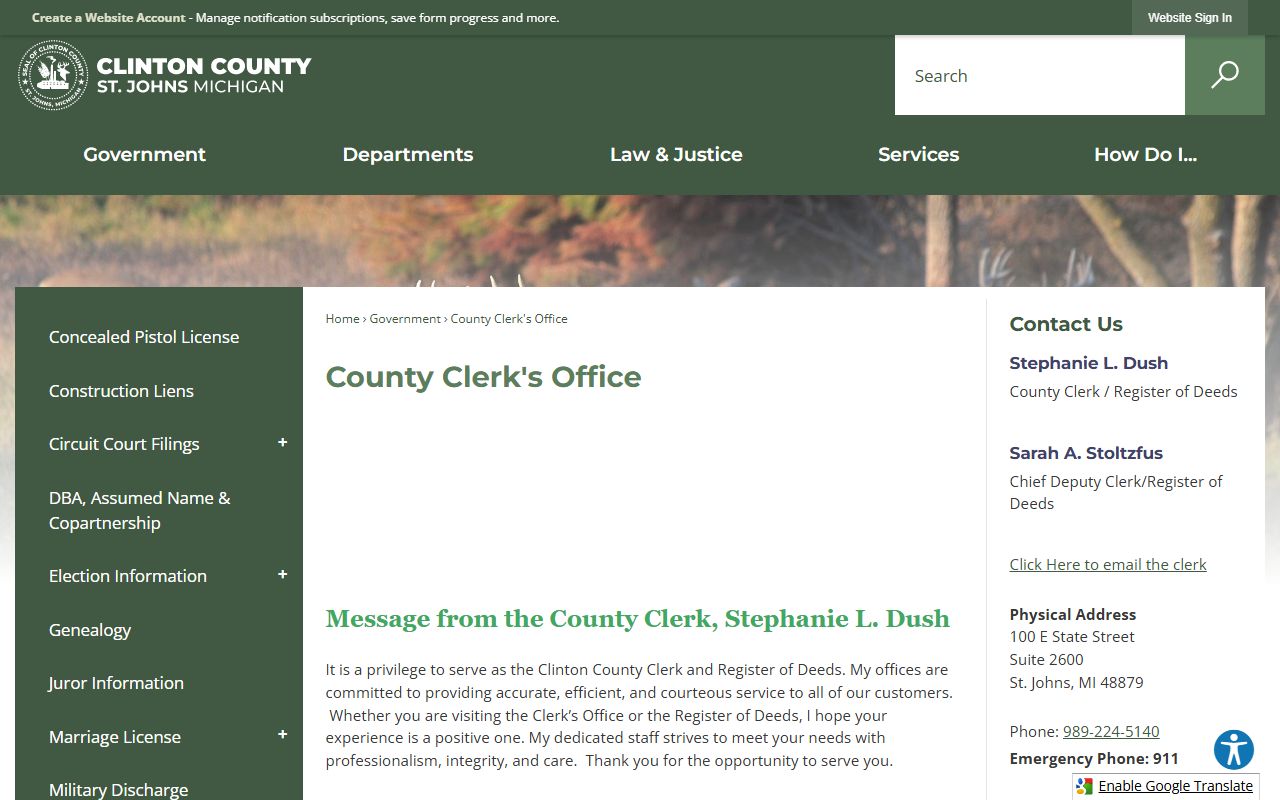
The clerk is the filing hub for circuit court cases and the registrar for vital records, so many record requests begin at that counter.
Public Access Laws for Clinton County Court Records
Court records in Michigan follow court rules rather than the state Freedom of Information Act. The judiciary is exempt from FOIA, so access to a case file is governed by the Michigan Court Rules and any statute or order that restricts a specific record. The general rule is that court records stay open unless a law or a judge closes them, and electronic documents must be available to the same extent as the paper file at the courthouse.
Key Statutes:
Michigan FOIA, Act 442 of 1976 - governs public records of agencies, but exempts the courts, so case files run on court rules instead.
MCR 8.119 - keeps court records open unless restricted, and makes public electronic documents available like paper.
MCL 780.621 - lets eligible people ask the convicting court to set aside qualifying convictions.
MCL 712A.28 - restricts juvenile case records, keeping them out of general public access since January 1, 2021.
State police records add one more layer. Under MCL 28.241, the Michigan State Police handle criminal and juvenile identification records, which matters once a court case feeds into a statewide criminal-history report.
Records That Are Restricted or Confidential
Not every Clinton County court record is open to the public. Juvenile case records are restricted, and since 2021 they are closed to the general public except for people with a legitimate interest, such as the juvenile, a parent, counsel, law enforcement, or the prosecutor. Adoption files and many mental-health proceedings handled by the Probate Court are also confidential and are not treated like ordinary civil records.
Set-aside convictions are a special case. A conviction that is set aside under Michigan's expungement law is not erased from existence, but the public-facing record must be redacted so it no longer shows. Personal identifying information is withheld across the board, so full Social Security numbers and financial-account details should not appear in an ordinary public file. To view a sealed record, a person usually must file a motion and show a legal reason the court will accept.
Specialty Courts in Clinton County
Clinton County takes part in two regional treatment courts that run alongside the standard docket. The Mid-Michigan Regional Sobriety Court serves Gratiot, Clinton, and Montcalm Counties and works with drunk and drugged driving offenders. It runs 12 to 24 months across four phases and requires treatment, drug testing, peer support, community service, case management, and review hearings. District Judge Andrew Stevens is one of the presiding judges.
The Mid-Michigan Regional Mental Health Court covers Gratiot, Clinton, Montcalm, and Ionia Counties. It follows a similar 12-to-24-month, four-phase model built around mental-health or co-occurring treatment, testing, peer support, and regular court reviews. Both programs accept eligible felony and misdemeanor offenders through a referral form. The county also lists Online Ticket Mediation, Conviction Set Aside, and probation classes as part of its court-services ecosystem.
Note: These treatment courts are administered regionally, so referral forms and program details are posted on the shared Mid-Michigan court pages rather than a Clinton-only site.
Clinton County Sheriff and Jail
The Clinton County Sheriff's Office runs patrol, court security, civil process, and the county jail from 1347 E Townsend Road in St. Johns. The main sheriff line is 989-224-5200, and a 24-hour jail and inmate information line answers at 989-227-6580. The Sheriff's Office page lists the FOIA email and appointment rules for property release and permit services.
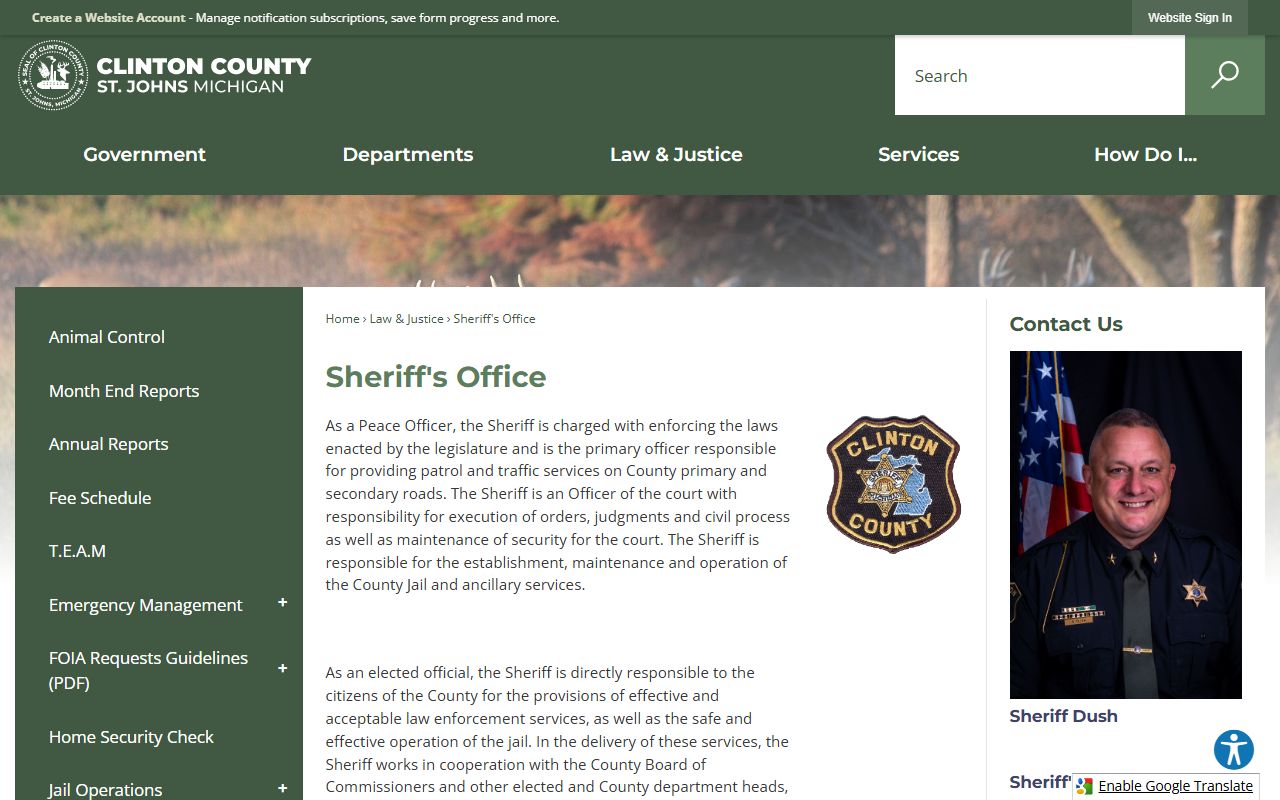
Because the sheriff handles court security and civil process, that office connects the courthouse to the jail on the custody side.
The jail opened in 1991 with a design capacity of 186 beds. A 2004 addition raised capacity to 216, and a 2012 addition brought it to 236. Sentenced inmates are charged a $35-per-day housing fee, and deposits can be made through expressaccount.com or by phone at 866-422-6833. The Jail Operations page describes commissary, billing, and money-deposit rules in detail.
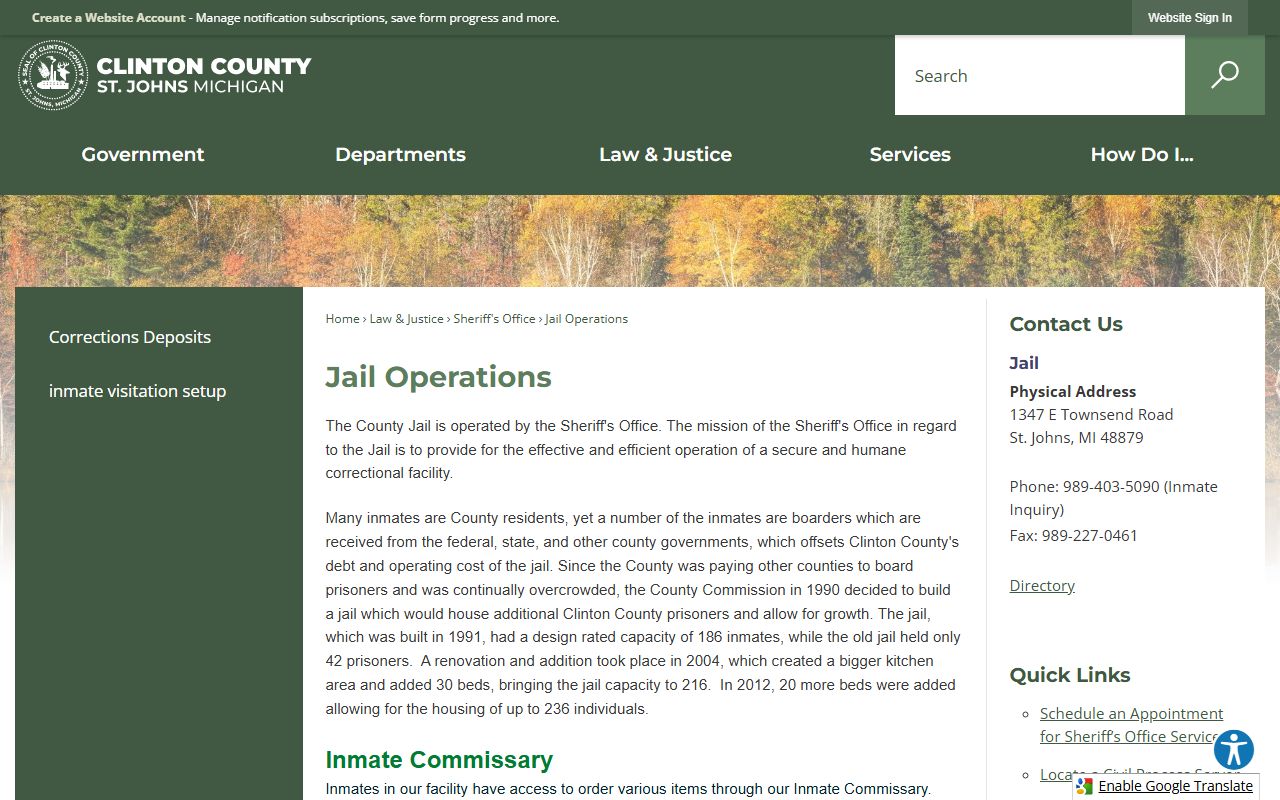
For a full custody lookup, the county points people to that jail line and office, since the site does not publish a public roster. See the Clinton County inmate records page for booking and custody detail and the warrant records page for active warrants.
Marriage, Divorce, and Probate Court Records
Marriage and divorce records split between two offices. The County Clerk issues marriage licenses and holds marriage records that date back to 1839, while divorce is a Circuit Court matter handled through its civil and family division. Probate Court, meanwhile, manages estates, guardianships, conservatorships, adoptions, will safekeeping, and even secret marriages. The Probate Court page warns that current State Court Administrative Office forms must be used, since older versions can be refused.
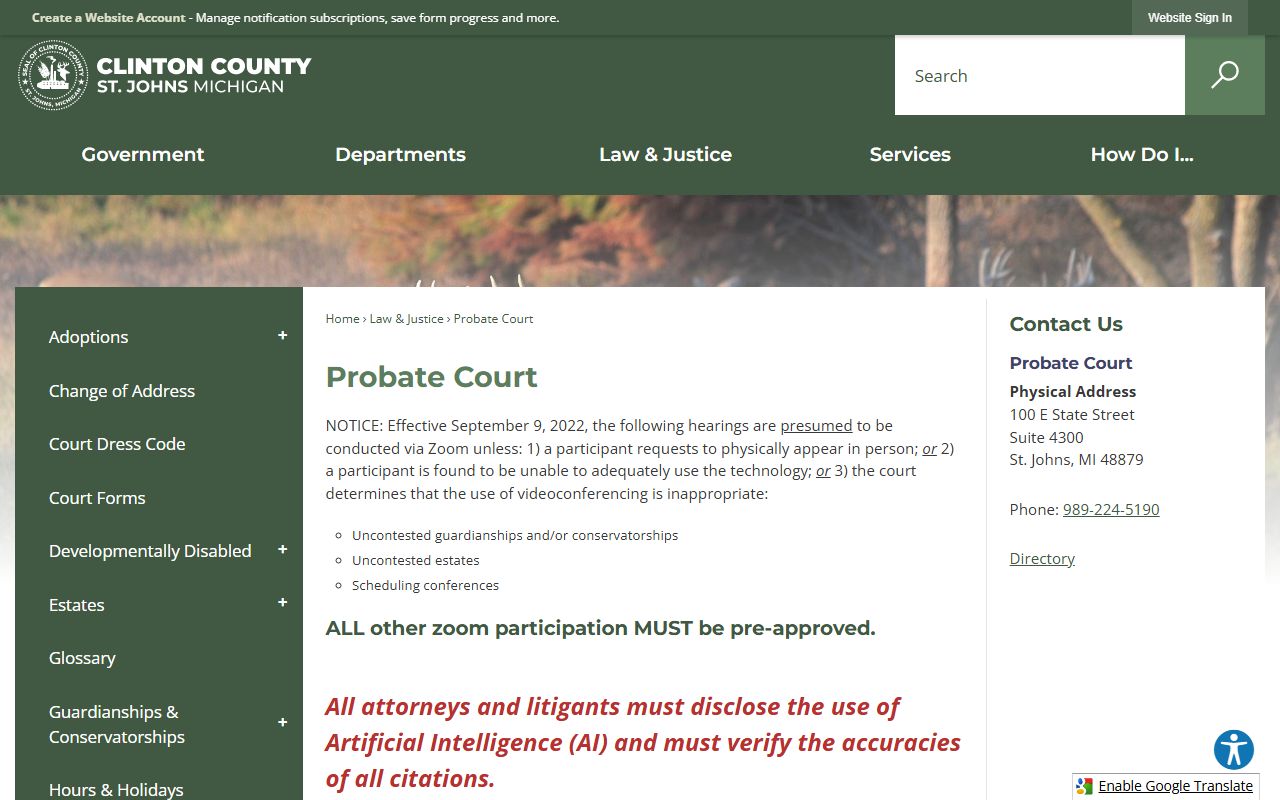
Probate Judge Lisa Sullivan also sits in the circuit family division, which ties estate and family matters closely together. For fuller detail, see the marriage and divorce records and Probate Court records pages.
- Testator
- The person who made a will.
- Executor
- The person named to carry out a will's instructions.
- Conservator
- Someone the court appoints to manage another person's finances.
- Intestate
- Dying without a valid will in place.
Clinton County Court Records Fees
The clerk publishes a clear fee schedule for copies and record searches. A circuit case search costs $10 per name for a 10-year search by mail or for newer records, though records before July 1996 can be searched in the office at no charge. Copy fees run per page, and certified copies add a flat certification charge on top of the per-page rate.
| Item | Amount |
|---|---|
| Court copy, first 10 pages | $2 per page |
| Court copy, after 10 pages | $0.50 per page |
| Certified copy | $1 per page plus $10 |
| Circuit case search | $10 per name, 10-year search |
| Faxed copies | $5 per page, 25-page limit |
| Marriage license, resident | $20 |
| Jail housing, sentenced inmate | $35 per day |
Mail requests must include a written request, a self-addressed stamped envelope, and a check or money order payable to the Clinton County Clerk. The clerk completes mailed searches within 24 hours of receipt.
How to Interpret Clinton County Court Records
Court files use shorthand that can confuse a first-time reader. A docket, or register of actions, is the chronological list of everything filed and ordered in a case. A disposition tells you how the matter ended, and a judgment is the final decision. A case dismissed without prejudice can be refiled, while one dismissed with prejudice cannot.
The most important distinction is between a charge and a conviction. A charge is only an accusation filed by the prosecutor, and a person is presumed innocent until the case resolves. A conviction is a finding of guilt after a plea or trial. A record that shows an open case or a dismissed charge is not the same as a criminal conviction, and reading the disposition field is the only reliable way to tell them apart.
Accuracy and Record Limitations
Online court data is a convenience copy, not the official file. The clerk's portal warns that data can lag filings by at least 24 hours and may change without notice. The Tyler self-service index describes itself as a library card catalog, which is why the county tells users to try every spelling variation of a name.
Note: Confirm any detail that affects a legal or financial decision with the clerk's office or the court that owns the record before relying on it.
History of Clinton County Courts
Clinton County's court history runs deep. The county seat moved from DeWitt to St. Johns after discussion began in 1855, with offices transferring by 1857. A small brick county building went up in 1858, and a larger courthouse approved in 1869 was completed in 1872, its dome famously struck by lightning in 1871. That courthouse served the county for roughly a century.
The current 117,000-square-foot courthouse was dedicated on June 22, 2000, and now houses the circuit, district, and probate courts along with the clerk and register of deeds. The county's Courthouse History page traces the full timeline from the first county building to the modern complex.
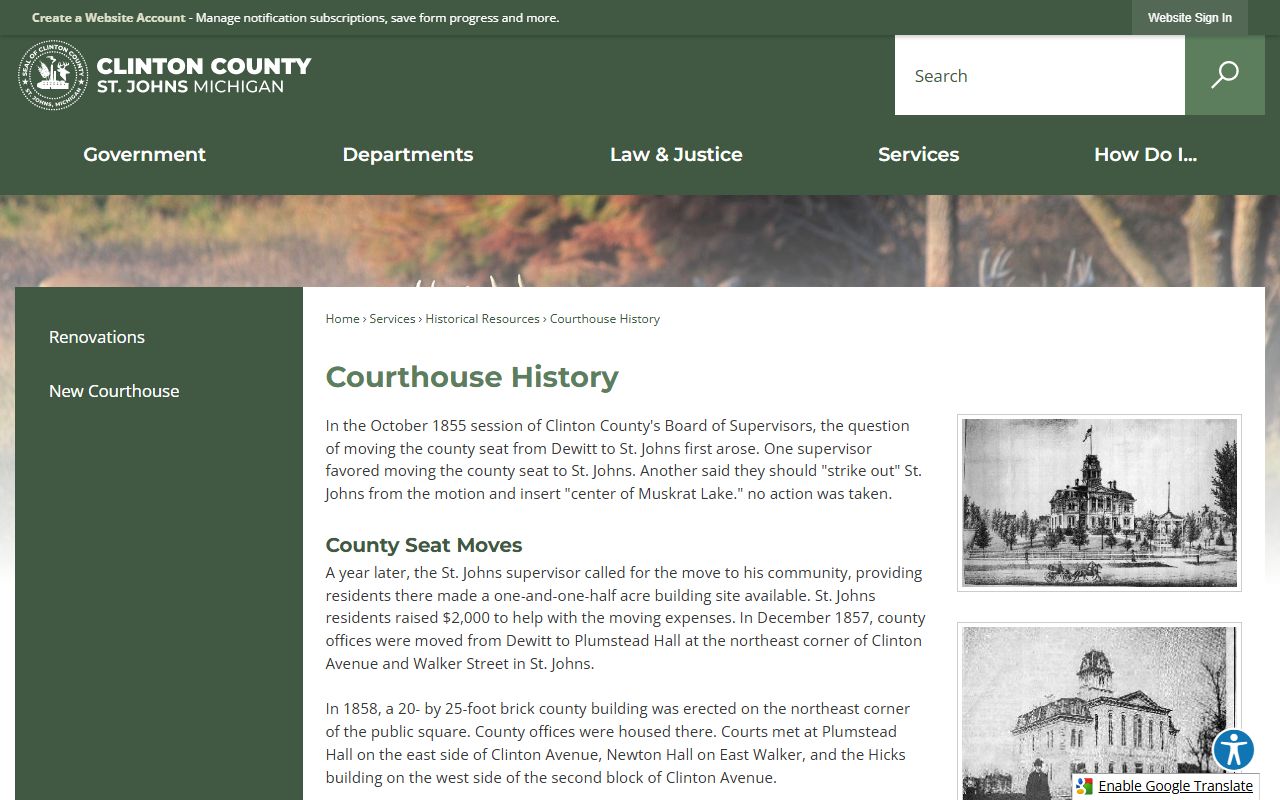
That continuity explains why the county keeps its historic building phases in view even as it modernized its court records and online tools.
Frequently Asked Questions
How do I search Clinton County court records online?
Start with the court that owns the record. Circuit Court cases use the county clerk record search and MiCOURT. District Court matters use the district court case inquiry and register of actions. Traffic and warrant matters use the 65A District Court's Court Innovations portal. Marriage, death, and assumed-name records use the clerk's Tyler self-service site. Older circuit files before July 1996 are searched in person or by mail.
Are Clinton County court records public?
Most are. Michigan court records stay open unless a statute, court rule, or judge's order closes them. The courts are exempt from the state FOIA, so access follows the Michigan Court Rules instead. Juvenile records, sealed files, adoptions, and set-aside convictions are restricted, and personal identifying information is redacted from public files.
Where is the Clinton County courthouse?
The main courthouse is at 100 E State Street in St. Johns, MI 48879. It holds the circuit court, district court, probate court, county clerk, and register of deeds in one 117,000-square-foot complex. The sheriff's office and jail are separate, at 1347 E Townsend Road in St. Johns.
How much does a certified copy cost?
Certified court copies cost $1 per page plus a $10 certification fee. Plain copies are $2 per page for the first 10 pages and $0.50 per page after that. A circuit case search costs $10 per name for a 10-year search, though pre-July-1996 records can be searched in the office at no charge.
How do I check on a warrant in Clinton County?
The county does not publish a single public warrant list. The 65A District Court's Court Innovations portal allows limited warrant and traffic review using a date of birth, driver's license, or case number. For outstanding warrant status, the county says to contact the police agency handling the case, since the prosecutor and court may not track its current status.
How do I find someone in the county jail?
The Clinton County jail does not post a public online roster. Custody questions go to the 24-hour jail information line at 989-227-6580 or the sheriff's office at 989-224-5200. Money deposits can be made through expressaccount.com or by phone at 866-422-6833, and property release is handled by appointment.
Where do I get a marriage or divorce record?
Marriage licenses and marriage records come from the County Clerk, whose marriage records reach back to 1839. Divorce is a Circuit Court matter handled in its civil and family division, so divorce records are found through circuit court case-search tools rather than the clerk's marriage portal.