
How Clinton County Handles Warrant Checks
Clinton County gives a plain answer about warrants, and it is worth taking at face value. Warrant status is not always found in one open list. The county's prosecutor FAQ states that the police department handling a case is the office responsible for locating and arresting a defendant, so the right contact for an outstanding-warrant question is that police agency, not a public database. The prosecutor's office authorizes the criminal complaint, but the court authorizes the arrest warrant. The prosecutor may not even know whether a given warrant is still open.
Because of that split, there are two practical paths for a Clinton County warrant search. The first is the online case review tool tied to the 65A District Court, which is available for certain matters. The second is the direct fallback: call the police agency handling the case, or send a public-records request to the sheriff. The captured county pages do not expose a sheriff-run active-warrant bulletin or a jail warrant roster, so both channels matter.
The result is a search that leans on the phone and the right office as much as on a screen.
Important: No open, countywide list of active Clinton County warrants is published for public browsing, so treat any site claiming a full live warrant roster with caution.
Online Warrant Review in Clinton County
The county's documented online channel for warrant and traffic review runs through the 65A District Court's Court Innovations platform. The county links it from the Online Warrant Review page, and the tool itself lives at the MID65A portal. It is an online case review tool, not a warrant printout. Eligible traffic tickets may be reviewed for possible no-point outcomes, and the court notes that a real judge and a law enforcement officer are on the other side of the review.
The platform's terms and privacy pages spell out how the review works before you submit anything. You can read them on the portal terms page, which sets out the ground rules for using the case review tool.
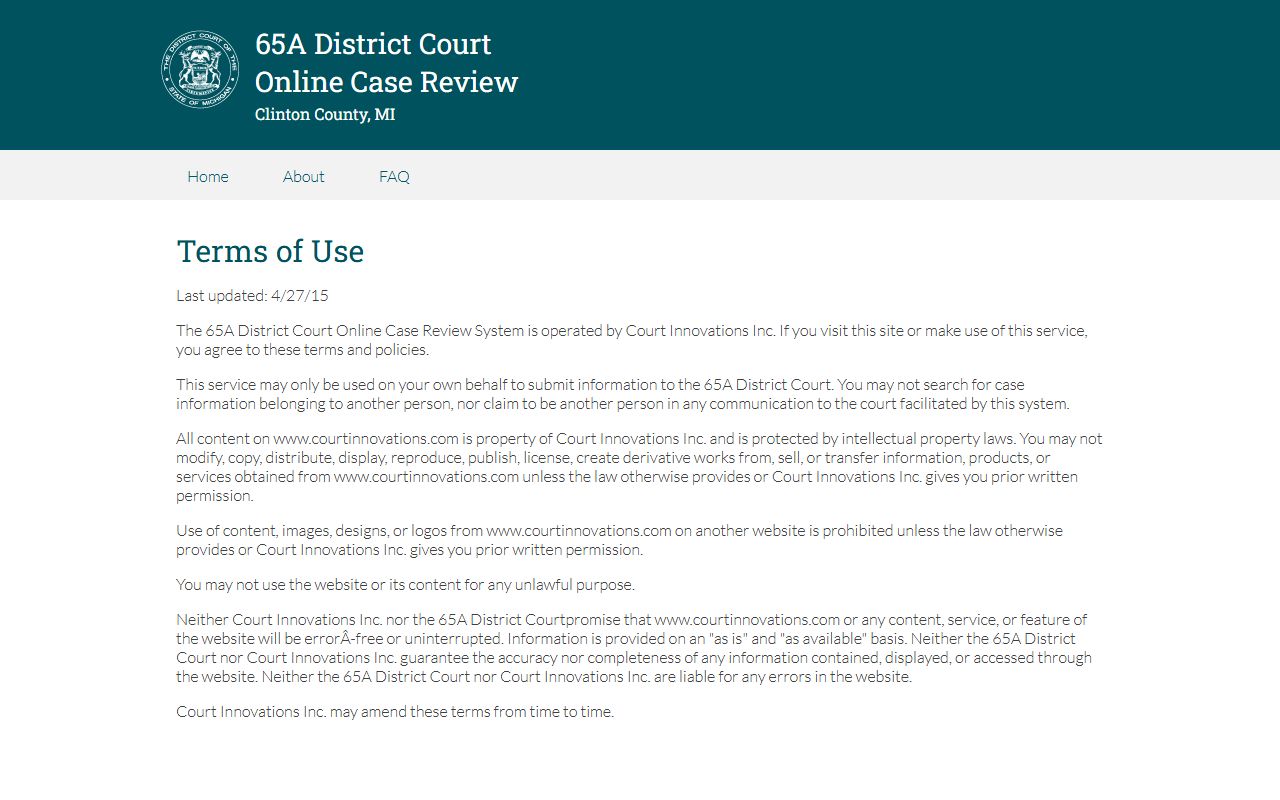
The screen above is the 65A Court Innovations entry point that Clinton County uses for warrant and traffic case review. It confirms the tool is a review portal for eligible matters rather than a browse-anyone active-warrant database.
Using the portal follows a short sequence.
- Open the MID65A portal and read the terms, privacy, and FAQ pages before starting.
- Choose the correct search form for your situation, such as the warrant review or a traffic matter.
- Enter the requested identifiers, submit the matter for review, and watch for a status update by email or text.
Clinton County Warrant Search Fields
The Court Innovations warrant search asks for identifiers that tie a person to a specific case, rather than a broad name sweep. The four fields on the warrant form are listed below. Because the search keys on a driver's license and case detail, it works best when you already know the case you are asking about.
| Field Label | Type | Required | Notes |
|---|---|---|---|
| Date of Birth | Date | Yes | Identifies the individual tied to the matter under review. |
| Driver's License | Text | Yes | The license number used on the citation or case. |
| Driver's License State | Select | Yes | The state that issued the license, often MI for local matters. |
| Case Number | Text | No | The court case or ticket number when it is known. |
These fields mirror how the district court organizes its online review: by person and by case, not by an open list anyone can scroll.
Traffic and No-Insurance Companion Searches
The same 65A portal carries two companion searches next to the warrant form, and they help explain what the tool is really built for. Both the traffic search and the DWLS/no-insurance search use a slightly different set of identifiers. Eligible traffic tickets written by the Clinton County Sheriff's Department and other participating agencies can be submitted for review, and users can receive status updates by email or text.
- Traffic search - driver's license number, driver's license state, and date of birth.
- DWLS / no-insurance search - driver's license number, driver's license state, and date of birth.
- Warrant search - date of birth, driver's license, driver's license state, and case number.
Reading these together shows the design. The portal reviews eligible citations and related matters, so a Clinton County warrant search through this tool is strongest when the warrant grows out of a traffic or license case rather than a serious separate charge.
Note: The portal is a review tool for eligible matters, so it will not resolve every warrant question, especially those unconnected to a citation.
Types of Warrants in Clinton County
Warrants come in several forms, and each starts differently. A judge or magistrate must authorize the ones that allow an arrest. Knowing the type helps you figure out which office to call and whether the online review tool is even the right place to look.
- Arrest warrant - issued by the court after the prosecutor authorizes a complaint, allowing police to take a named person into custody.
- Bench warrant - ordered by a judge when someone misses a court date or ignores a court directive.
- Search warrant - signed by a judge or magistrate to let officers search a place or property for evidence.
- Capias / failure-to-appear - a hold or pickup order tied to a missed appearance or an unpaid court obligation.
In every case the police agency that handled the underlying matter is the office responsible for serving the warrant and making an arrest.
What a Clinton County Warrant Record Shows
Clinton County did not expose a sample warrant result page in the sources reviewed, so there is no public field-by-field screenshot to copy here. The list below reflects the standard elements a warrant record generally carries once it is confirmed through the court or the arresting agency. Treat it as a guide to what you would ask about, not as a live public readout.
| Field | What It Shows |
|---|---|
| Warrant Number | The unique identifier the court assigns to the warrant. |
| Issue Date | The date the judge or magistrate authorized the warrant. |
| Charge | The offense or violation named in the underlying complaint. |
| Bond Amount | Any bond the court set for release, when one applies. |
| Issuing Court | The court that authorized it, typically the 65A District Court or the Circuit Court. |
Because there is no open roster, confirming these details usually means contacting the handling agency or the court that authorized the warrant.
Other Ways to Check Warrant Status
When the online review tool does not answer the question, the fallback chain is the more reliable route in Clinton County. The prosecutor cannot tell you whether an arrest warrant is still open, so the first call goes to the police agency that handled the case. For records that fall under the state's public-records process, the sheriff's office accepts requests by email under the Freedom of Information Act. General court questions can also go to the court that would have authorized the warrant.
The Clinton County Sheriff's Office administers the jail and executes court process, and it publishes an appointment-based approach for many in-person services. You can review its administrative and appointment information before visiting or calling.
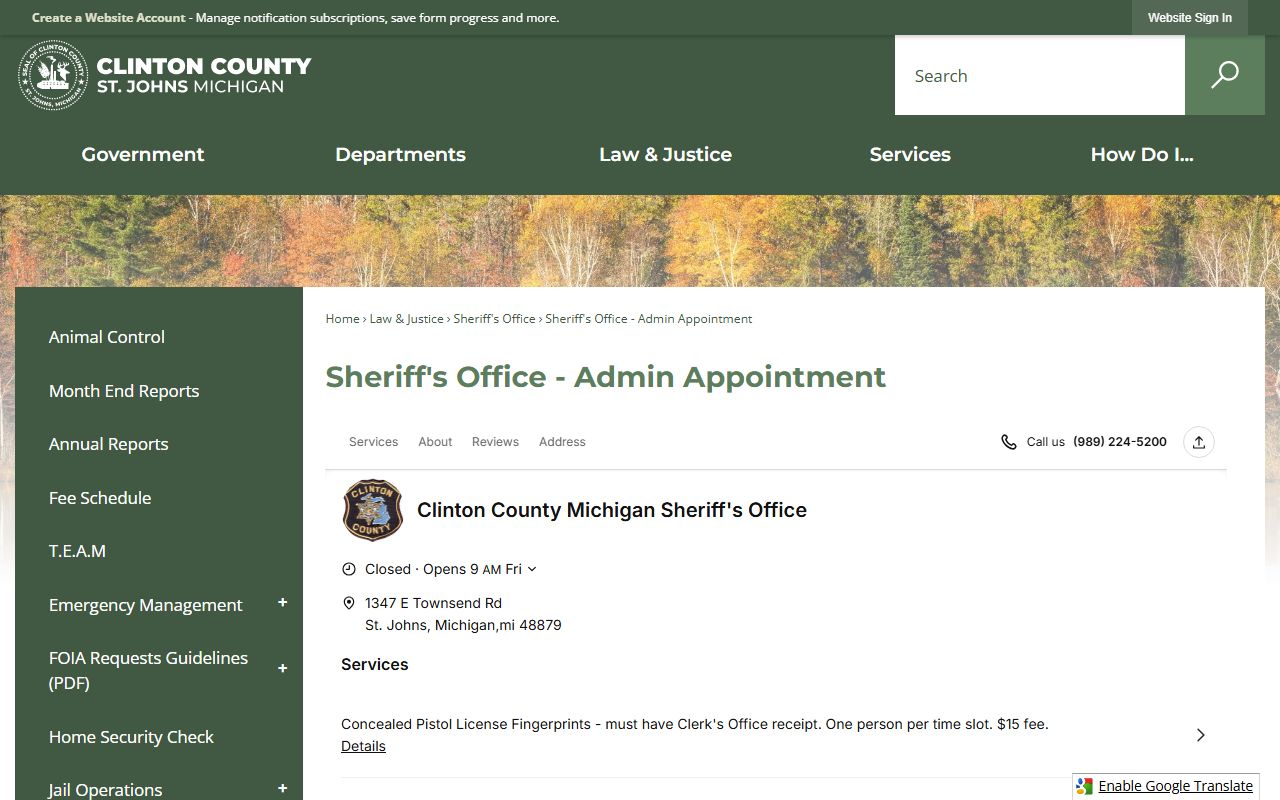
The page shown above is the sheriff's office administrative and appointment section, which is the operational fallback for custody and records questions that the online tool cannot resolve. It reinforces that many sheriff services run by appointment rather than walk-in.
The channels below cover the practical ways to run down warrant status in the county.
Clinton County Sheriff's Office
1347 E Townsend Road
St. Johns, MI 48879
Sheriff: 989-224-5200
Jail / inmate info (24 hr): 989-227-6580
FOIA requests: sherifffoia@clinton-county.org
- Police agency handling the case - the office responsible for locating and arresting a named person, and the right contact for outstanding-warrant status.
- Sheriff FOIA request - email sherifffoia@clinton-county.org for records that fall under Michigan's public-records process.
- Issuing court - the 65A District Court or the Circuit Court that authorized the warrant can confirm court-side detail.
What to Do If You Have an Outstanding Warrant
Finding out that a warrant may be open is unsettling, but there is a clear order of steps. Remember the split in roles: the court authorizes the warrant, while the prosecutor authorizes the complaint behind it, and the police agency serves it. That means you generally cannot make a warrant go away by calling the prosecutor, and a victim cannot simply drop charges. Handling it correctly protects your options.
- Confirm the warrant with the police agency that handled the case, since that office tracks whether it is still open.
- Talk to a lawyer before acting, especially about bond, arraignment, and how a court-appointed attorney is requested from the judge.
- Arrange to address it, which may mean posting bond, scheduling an appearance, or surrendering through the handling agency.
Acting on good information beats guessing. A short call to the right office tells you what the warrant is, what bond may apply, and which court will hear the matter. If the warrant ties to a filed case, the full case history sits in the Clinton County criminal court records.
Important: Speak with a defense attorney before turning yourself in, so you understand bond, timing, and your rights before you walk into custody.
Restricted Clinton County Warrant Records
Not every warrant is open to public view, and several categories stay shielded by law or by court order. This is one more reason a public list would never show everything. Sealed warrants are held back so that a suspect is not tipped off before an arrest. Search warrant affidavits can be restricted while an investigation is active.
Juvenile matters are handled separately and are far more limited in public access than adult cases. Federal warrants do not appear in county channels at all, since they run through the federal court system rather than the 65A District Court or the Circuit Court. When a record is restricted, the county's public tools will not display it, and the arresting agency or the court controls any release.
For custody-side questions once someone is arrested, the jail booking picture is covered in the county inmate records.