
How to Search Clinton County Court Records
The clerk's public record search, branded CaseLook, is the main starting point for circuit court case files. It opens on a disclaimer screen that warns records can lag the actual filing by at least 24 hours and may change without notice. After the disclaimer is accepted, the portal presents a name, role, and date search rather than a single case-number box. Circuit court records filed after July 1996 can also be reached through the county's Circuit Court Case Inquiry link and the statewide MiCOURT case search, which pulls civil, traffic, criminal, domestic, and probate matters depending on the court selected. The clerk CaseLook portal handles the clerk's own index.
A search runs best with the full name of a party, and it helps to try every spelling variation because the index behaves like a library card catalog. A case number, an attorney name, an agency name, or a judge name will also narrow the results. District court traffic and misdemeanor matters follow a different path: the 65A District Court case inquiry and its MiCOURT D65A view expect a name or case number, while the county's Court Innovations review tool asks for a driver's license number, state, and date of birth. Deciding the court level first saves the most time.
- Decide which court holds the record. Felonies, divorce, family matters, and civil suits over $25,000 are circuit court files; misdemeanors, traffic, small claims, and evictions are 65A District Court files; estates and guardianships are probate files.
- Open the CaseLook clerk search, read the disclaimer, and click Continue to reach the form.
- Enter a party name, or narrow the search by attorney, agency, or judge, and add a begin and end date to limit the range.
- For district court matters, switch to the 65A District Court case inquiry or the MiCOURT D65A path, and use Court Innovations for eligible traffic or warrant review.
- If the file is older, sealed from online display, or simply not indexed online, request it at the clerk's counter or by mail.
Clinton County Court Records Search Fields
The CaseLook form is built around who is on a case and when it moved, not around a case number alone. The linked page code shows fields for an attorney name, an attorney code, and an attorney ID, plus an agency name and code, a judge name and initials, a general name box, a case type, and a begin and end date. Clicking one field clears the others in most configurations, so a search usually runs on one lead value at a time. The result grid was not exposed in the county's static pages, so the columns a search returns are described here honestly as a name, role, and date search whose output layout is set by the clerk's system.
| Field | Type | Notes / Format |
|---|---|---|
| Name | Text | Party name search; try all spelling variations. |
| Attorney Name | Text | Search by the attorney of record on a case. |
| Attorney Code / ID | Text | Bar or system identifier when the name is unknown. |
| Agency Name / Code | Text | Filing or law-enforcement agency tied to the case. |
| Judge Name / Initials | Text | Assigned judge, entered by name or initials. |
| Case Type | Dropdown | Limits results to a category of case. |
| Begin / End Date | Date | Date range; blank date fields may default to today. |
The clerk record search sits behind a disclaimer for a reason. The county page linked here as the CaseLook record search was captured mid-search, and it shows the county's own posture toward the data.
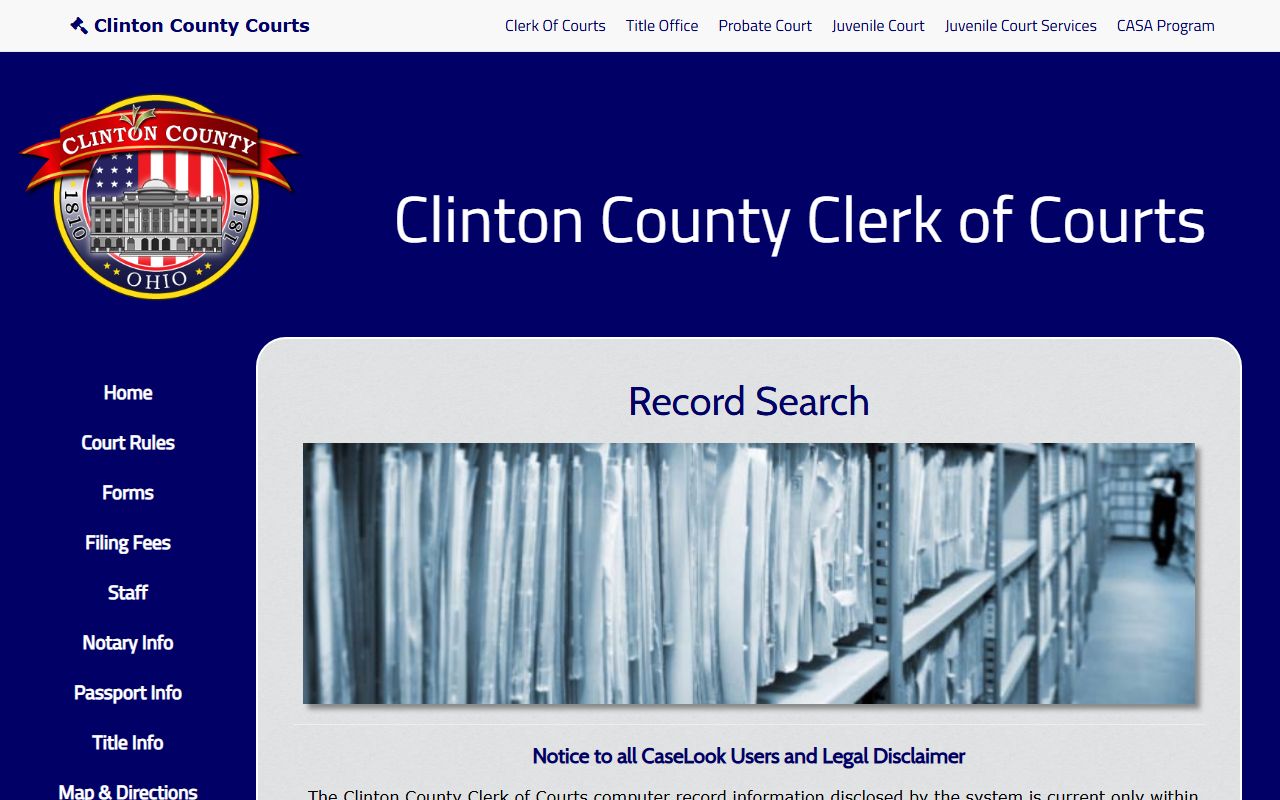
The screen confirms that the county treats the online index as a starting reference rather than a certified record, which is why verified information is requested from the clerk or checked in person.
Where Clinton County Court Records Live
The most important local rule is that not all records live in one place. Circuit court records run through the County Clerk and MiCOURT. District court matters have their own county case inquiry and a MiCOURT D65A view. Probate has its own court. Marriage, death, and assumed-name (DBA) filings live in the clerk's Tyler-hosted self-service portal instead of a general court docket. Matching the record type to the right channel is the whole task, and using the wrong portal is the most common reason a search comes back empty.
For circuit cases, the county's own case inquiry page is the friendliest front door. The link below opens the Circuit Court Case Inquiry page the county publishes for its main trial court.
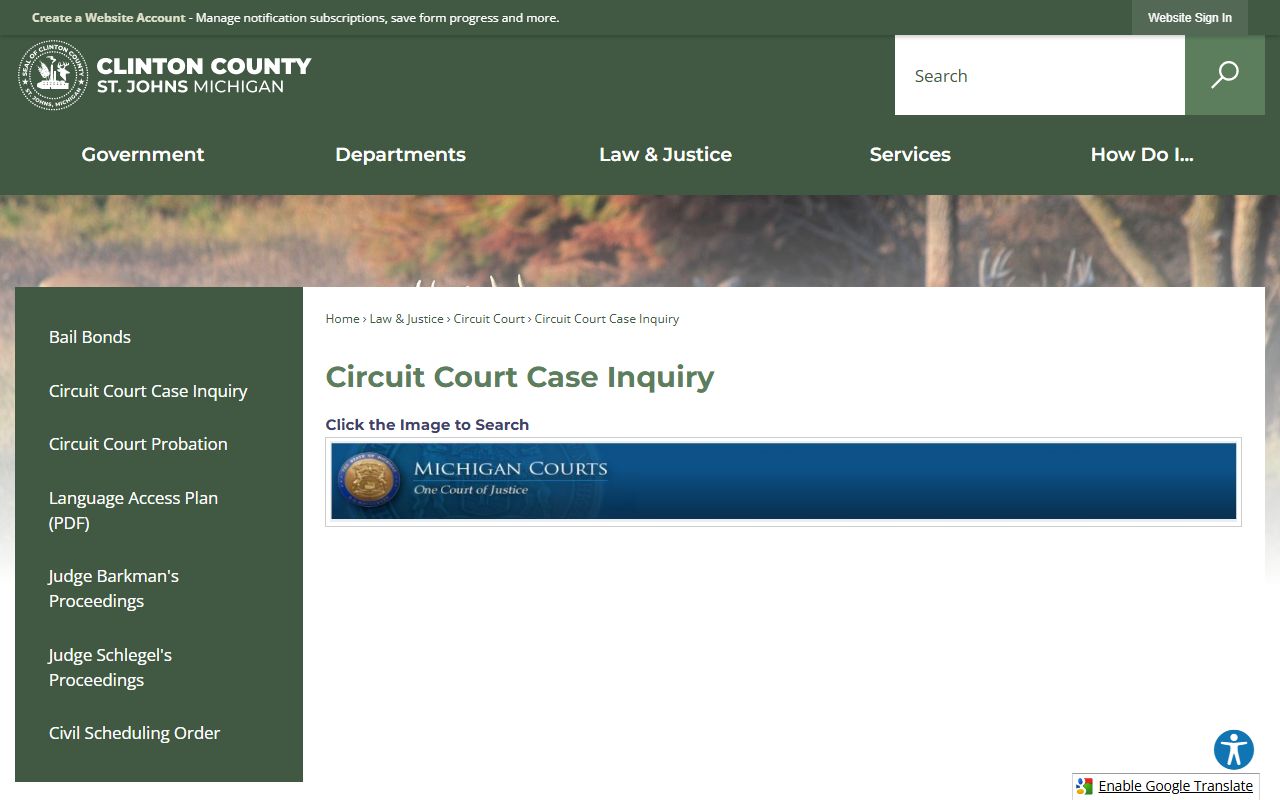
That page routes circuit searchers into the clerk's index and the state system rather than asking them to guess a case number. District court users take a parallel route through the state portal's county-specific path.
The 65A District Court view of the statewide system is reached at a dedicated D65A path. The link below opens the MiCOURT D65A case search for Clinton County's district court.
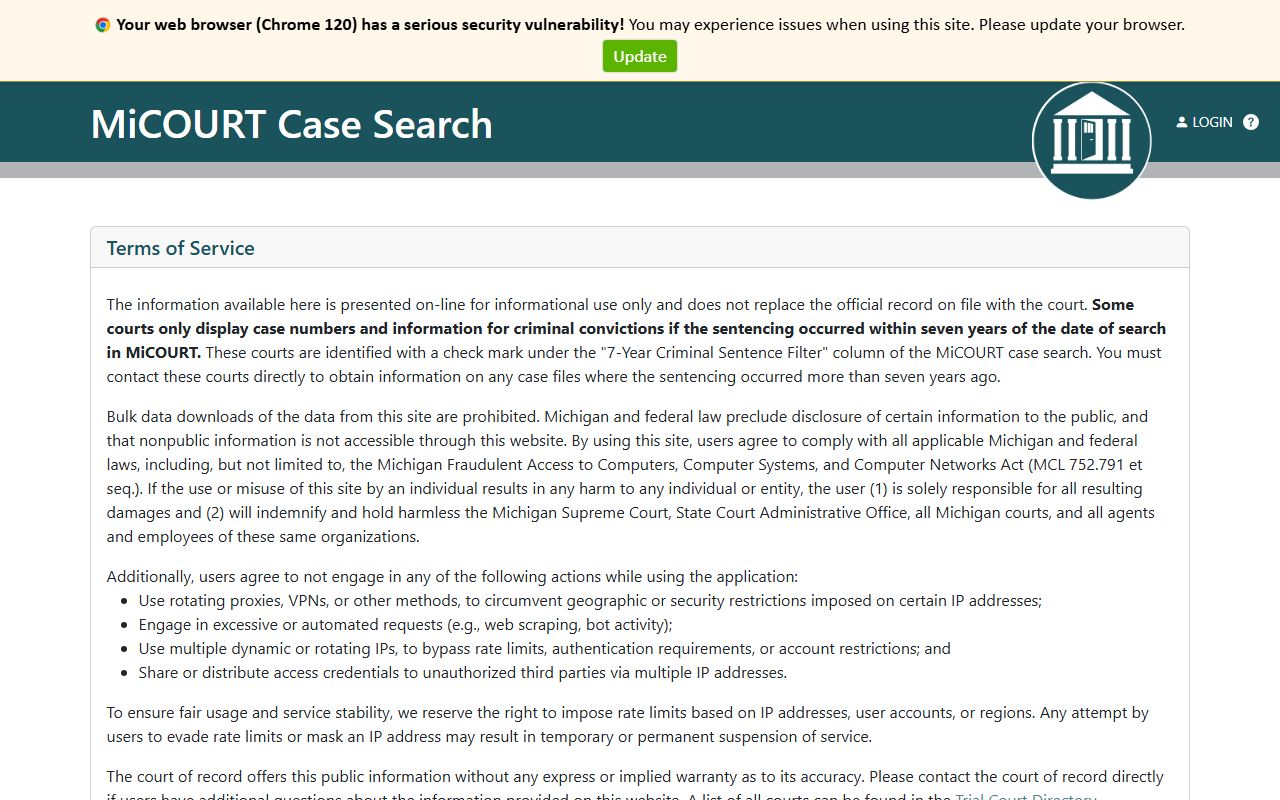
This D65A view is where misdemeanor, traffic, and civil-infraction cases surface once they are entered by the district court. Eligible traffic and warrant matters can also be reviewed through the county's Court Innovations tool, which is covered in the Clinton County traffic court records.
The wider net is the general MiCOURT search, which lets a user pick any participating Michigan court. The link below opens the statewide MiCOURT case search home screen.
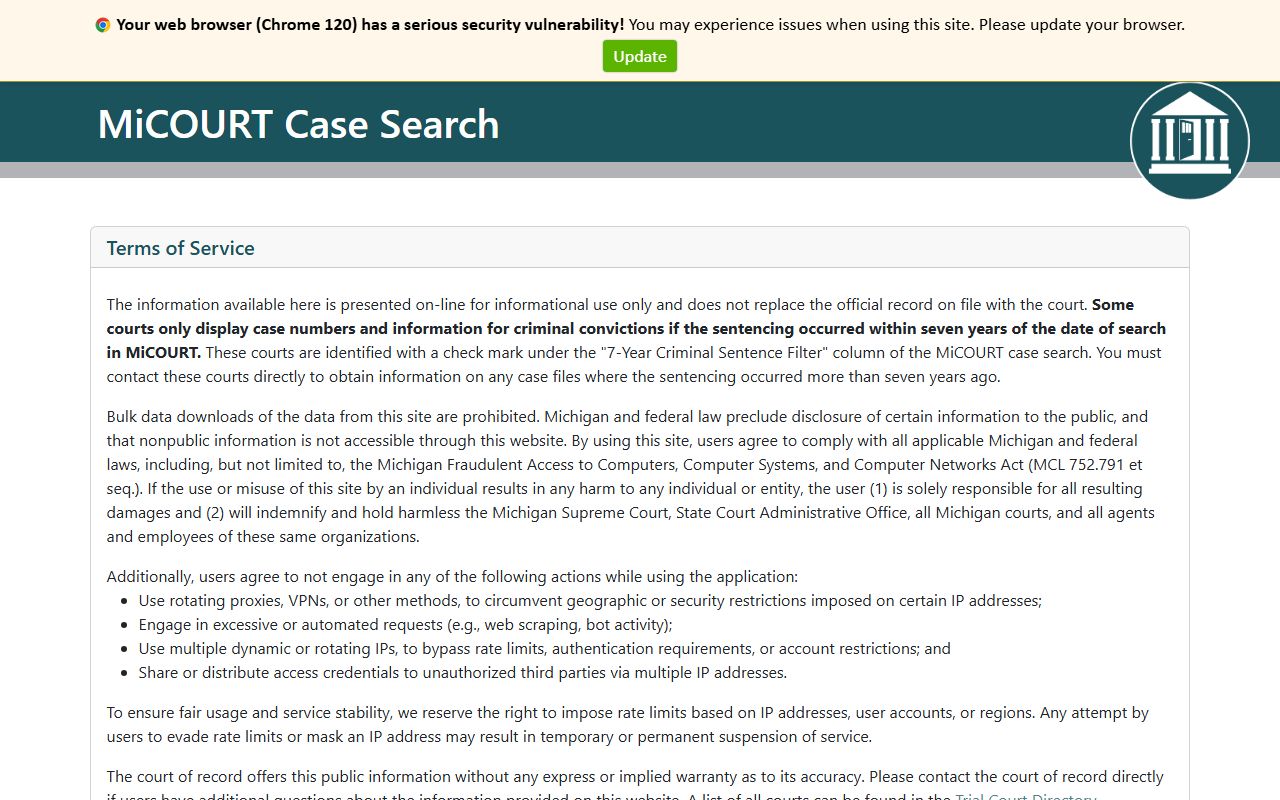
Some searchers start at the county and end at the state portal, because MiCOURT is the officially linked route for both circuit and district court records. Marriage, death, and DBA records take yet another path: the county clerk's Tyler self-service site, a gated, catalog-style index that asks users to try spelling variations and warns that its data can change without notice.
Types of Clinton County Court Records
The record set follows the court structure. The 29th Judicial Circuit Court, shared with Gratiot County, produces felony files, civil files over $25,000, and the full family-division record for divorce, paternity, name change, and personal protection orders. The 65A District Court produces misdemeanor and ordinance files, traffic and civil-infraction records, small claims, evictions, garnishments, and the paperwork from felony preliminary exams before a case is bound over.
Probate Court keeps a separate set covering estates, guardianships, conservatorships, trusts, adoptions, and mental-health matters. Older paper files add a fourth category, since circuit records before July 1996 are not part of the online index and must be pulled by hand.
- Civil records, including complaints, answers, motions, orders, and judgments across both circuit and district court.
- Criminal records, from district misdemeanor files to circuit felony files, including warrants, plea paperwork, and sentencing.
- Family records, such as divorce, paternity, name change, support, adoption, and personal protection orders.
- Traffic and civil-infraction records, most of which route through the district court, not the circuit court.
- Probate records for estates, guardianships, conservatorships, and will safekeeping.
- Older pre-July-1996 circuit files and other non-digitized documents held only on paper.
What Clinton County Court Records Show
A court record is more than a verdict. It is the running history of a case, from the first filing through the final order, and the county portals show or imply a consistent set of fields. Case numbers drive the state search and the Court Innovations tool. Party names, filing dates, case types, judge assignments, docket entries, hearing dates, dispositions, and financial obligations round out the file. Michigan public records leave out protected identifiers, so a searcher should not expect full Social Security numbers or financial-account details in an ordinary public case.
| Field | What It Shows |
|---|---|
| Case Number | The court's unique file identifier, used to pull the full record. |
| Filing Date | When the case was opened with the court. |
| Parties | Names of the plaintiff, defendant, petitioner, or respondent. |
| Case Type | Category such as civil, criminal, family, traffic, or probate. |
| Judge | The judge assigned to hear and decide the matter. |
| Docket Entries | The chronological list of filings, motions, and orders, also called the register of actions. |
| Hearing Dates | Scheduled and past court dates tied to the case. |
| Disposition | How the court resolved the matter, such as dismissed, pled, or judgment entered. |
| Financial Obligations | Costs, fines, and fees ordered in the case. |
| Status | Values such as open, closed, disposed, transferred, sealed, or nonpublic. |
The county does not expose a stable case-number format guide or a live sample record page, so exact column order varies by portal. The docket entries are the most useful part for tracking a case, because they show every step in order and point to the full case file kept by the clerk.
Public Access Framework for Clinton County Court Records
Court records are open in Michigan, but not through the usual public-records channel. The Michigan Freedom of Information Act, Act 442 of 1976, governs the records of public bodies, yet it exempts the judicial branch. That means a request for a court file is not a FOIA request against the judiciary. Instead, access runs through the court rules. Under MCR 8.119, court records are open unless a statute, court rule, or court order restricts them, and public electronic documents must be available to the same extent as the paper file at the courthouse.
In practice, any member of the public can search the county portals or ask the clerk for a file, without proving a reason. Fees attach to copies and searches, not to viewing. The state's own trial court records-management guidance sets the framework the county follows for keeping and releasing case files.
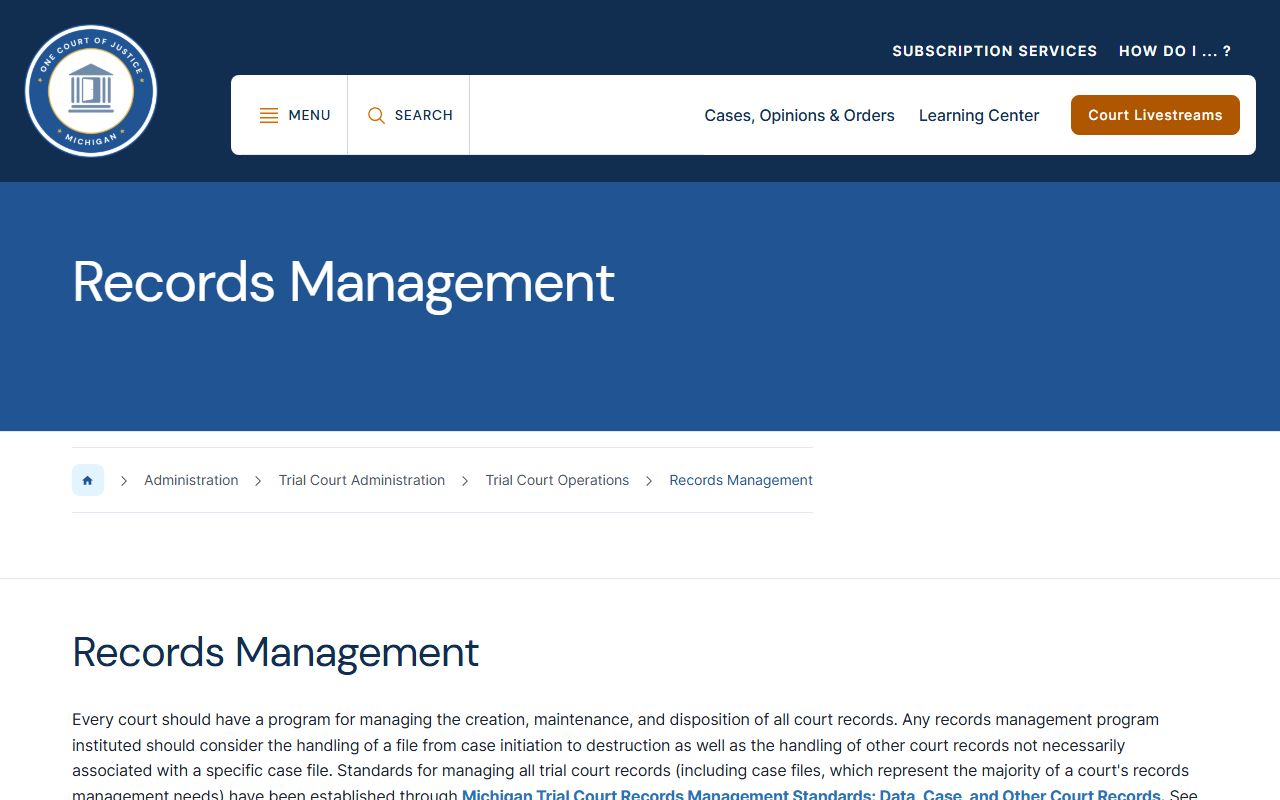
The guidance reinforces that open access is the default and that redaction, not denial, is the tool for protecting sensitive detail inside an otherwise public file.
Note: Court records are governed by Michigan court rules rather than the state FOIA, so a request for a case file goes to the court that holds it, not through a FOIA process.
Records That Are Sealed or Confidential in Clinton County
Some files are closed to the general public. Juvenile case records are the clearest example. Under MCL 712A.28, juvenile records are kept out of general public access, and only people with a legitimate interest, such as the juvenile, a parent, counsel, law enforcement, or the prosecutor, may reach them without a court order. Adoption files and many mental-health proceedings handled by the probate court are also treated as confidential rather than ordinary public civil records.
Convictions that have been set aside are restricted, not erased. The set-aside statute, MCL 780.621, lets eligible people ask the convicting court to set aside qualifying convictions, and once that happens the public-facing record is redacted or withheld. Michigan court rules and benchbook guidance also require that personal identifying information be masked, so full Social Security numbers and account details do not appear in the public copy.
To view a record that is sealed or restricted, a person generally must show a legitimate interest or file a motion with the court that holds the file. The judge decides whether to open it. When a record is set aside, the process runs through the same court that entered the conviction, and the county's conviction set-aside references confirm that path is active locally. The Clinton County Clerk can confirm whether a specific file is public before a copy is ordered.
In-Person and Mail Court Record Requests
When a file is old, not online, or needed as a certified copy, the clerk's counter and mail service take over. Circuit court records before July 1996 can be searched in the clerk's office at no fee, or by mail for $10 per name for a 10-year search. Records after July 1996 can be searched online, in person, or by mail on the same $10-per-name terms. Mail requests must include a written request, a self-addressed stamped envelope, and a check or money order payable to the Clinton County Clerk, and the clerk completes a mailed search within 24 hours. Copies carry their own charges, shown below.
| Service | Fee |
|---|---|
| Circuit case search (mail or newer records) | $10 per name, 10-year search |
| Pre-July-1996 circuit search, in office | No fee |
| Copies, first 10 pages | $2 per page |
| Copies, after 10 pages | $0.50 per page |
| Certified copy | $1 per page plus $10 |
| Faxed copies | $5 per page, 25-page limit |
| Documents or data by email | $5 per document, up to 10 |
| Documents or data on USB | $15 plus postage if applicable |
The clerk's office is the filing hub for circuit court legal documents, so it is also the place to confirm a fee, pull an older file, or order a certified copy for court use. Visitors should plan around the midday closure and the 4:30 p.m. arrival cutoff.
Clinton County Clerk / Register of Deeds
100 E State Street, Suite 2600
St. Johns, MI 48879
989-224-5140
Mon-Fri 8-noon and 1-5; closed noon-1; arrive by 4:30 p.m.