
What the Probate Court Handles in Clinton County
Probate is often described as the court for wills and estates, and that is where most people first meet it. When someone dies, the Clinton County Probate Court oversees how their property is gathered, debts are paid, and what is left goes to the right heirs. It appoints and supervises the person who runs the estate, whether the deceased left a will or not. Trust proceedings and the estates of deceased persons form the core of the docket.
The court's reach is much wider than that. In Clinton County, the Probate Court also handles guardianships and conservatorships, cases involving persons found to be mentally ill or developmentally disabled, condemnation and drain cases, and adoptions. It hears juvenile delinquent cases and dependent or neglect cases, and it manages Clinton County Youth Home and Child Care Fund matters. That mix places the probate bench close to the lives of families across the county.
Several duties surprise people who expect estates only. The court processes name changes, emancipation of minors, and acknowledgements of paternity. It accepts secret marriages, handles recall petitions and related hearings, and takes wills and codicils for safekeeping during a person's lifetime. Probate in this county is broader than estates alone, and knowing that helps a searcher aim at the right file.
Probate Terms Defined
Probate paperwork leans on a handful of words that carry precise legal meaning. A file can read very differently once these terms are clear, so a short glossary helps before searching or reading an estate record.
- Testator
- The person who made and signed a will, setting out how their property should pass after death.
- Executor
- The person named in a will to carry out its terms; in Michigan this role is often called the personal representative.
- Intestate
- Dying without a valid will, in which case state law decides who inherits the estate.
- Guardianship
- A court arrangement giving one person legal authority over the personal care and decisions of a minor or an incapacitated adult.
- Conservatorship
- A court arrangement placing a protected person's money and property under someone appointed to manage those financial affairs.
Guardianship and conservatorship often travel together but are not the same thing. One protects the person, the other protects the estate, and a single case can create both roles for the same protected individual.
How to Search Clinton County Probate Records
There is no single one-click probate database that answers every question in Clinton County. The county did not publish a full probate case-search field inventory in its captured court pages, so the honest path is a short chain of channels rather than one portal. The Probate Court itself is the office of record, and it holds the complete file. Direct contact by phone or a visit to the court is the surest way to confirm a case, a hearing date, or the status of an estate.
The statewide layer helps when a county page falls short. Michigan's MiCOURT case search is the officially linked route for court records, and the state notes that civil, traffic, criminal, domestic, and probate cases may be available depending on the court. Probate cases may appear there, but availability varies by court, so a blank result online does not mean no file exists at the courthouse.
- Start with the Clinton County Probate Court page to confirm the judge, the court schedule, current forms, and the online payment link before you call or file.
- Call or visit the Probate Court to confirm a case number, a hearing, or the personal representative, since the full file lives with the court.
- Check MiCOURT for a statewide view, remembering that probate availability depends on the individual court.
Related vital records sit with a different office. Death certificates, marriage records, and similar documents are handled by the County Clerk rather than the Probate Court, and those are described on the County Clerk page. When an estate question turns on proving a death or a family relationship, the clerk's records are the companion piece to the probate file.
Clinton County Probate Court Office
The Probate Court is a separate county court, distinct from the 29th Judicial Circuit Court and the 65A District Court, though all three sit in the same courthouse complex in St. Johns. Judge Lisa Sullivan presides over the Probate Court and is also assigned to the family division of circuit court, a pairing that keeps probate and family matters closely connected in the county's structure. That overlap is why a guardianship, an adoption, or a paternity question can feel like it touches more than one court at once.
Clinton County Probate Court
100 E State Street
St. Johns, MI 48879
989-224-5190
Monday to Friday, regular county courthouse hours
Because Judge Sullivan carries both a probate and a family-division assignment, a single family's issues can appear across the probate and circuit dockets. Anyone unsure which court holds a file should start with the Probate Court's own phone line, since staff there can point a caller toward the correct division.
Probate Filing Fees and Copy Costs
Copy and certification fees for Clinton County court records are published and consistent across the courthouse offices. Statutory filing fees for opening an estate, a guardianship, or a conservatorship are set by Michigan law and are not laid out as a probate-specific dollar list in the county's captured pages, so the court itself or its online payment link is the place to confirm a current filing amount. The copy figures below apply to court records the office releases.
| Item | Amount |
|---|---|
| Court copy, first 10 pages | $2 per page |
| Court copy, after 10 pages | $0.50 per page |
| Certified copy | $1 per page plus $10 |
| Fax (cover sheet included, 25-page limit) | $5 per page |
| Records by email | $5 per document, up to 10 documents |
| Records on USB drive | $15 plus postage if mailed |
Certified copies matter for probate. A bank, a title company, or another court will usually accept only a certified copy carrying the court's seal, not a plain print. The Probate Court publishes its own court schedule and an online payment link, so filers can confirm the exact statutory fee for their petition before they file. Note: The court warns that using the wrong version of a required form can result in a refusal to file, which delays a case and can add cost.
Filing With Current SCAO Forms
Michigan probate runs on standardized forms approved by the State Court Administrative Office, and Clinton County is strict about them. The Probate Court requires the current State Court approved forms and warns that these forms change frequently and without notice. Using an outdated version is not a small clerical slip in this court.
The consequences are concrete. The court states that submitting the wrong version can result in a refusal to file and delays to the case. For an estate on a deadline or a guardianship needed quickly, a rejected form can push a hearing back by weeks. Downloading fresh copies at filing time, rather than reusing a saved packet, is the safer habit.
The county's PII guidance shapes what actually goes on those forms. Michigan courts direct filers to keep protected personal identifying information off public documents, as explained in the state's personal identifying information guidance.
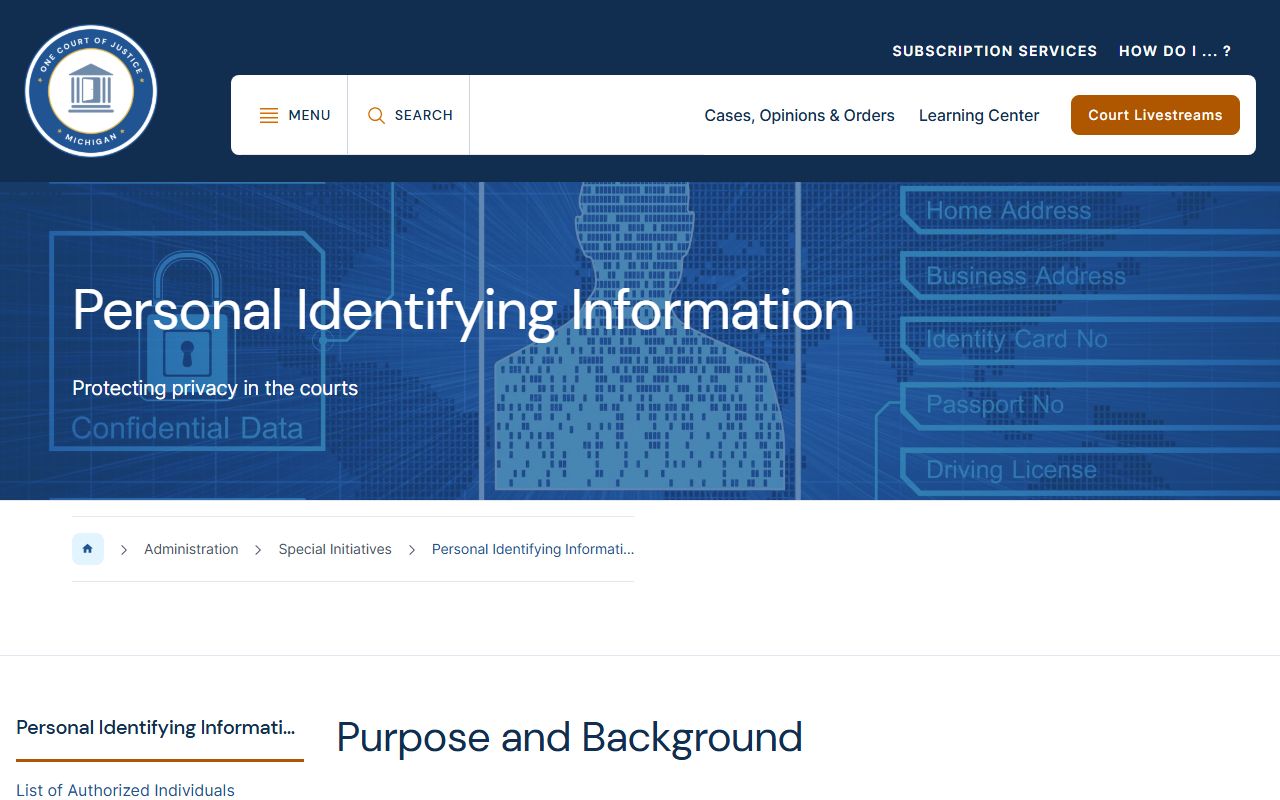
That guidance is why a probate file open to the public still hides full Social Security numbers and financial account details. Filers submit sensitive identifiers on separate protected forms, keeping the public estate record readable without exposing private data.
Will Safekeeping in Clinton County
One probate service happens long before anyone dies. Clinton County explicitly lists will safekeeping among the Probate Court's duties, letting a living person deposit a will and any codicil with the court for safe storage. It is a quiet but useful protection against a will being lost, destroyed, or hidden.
Michigan law backs the service directly. Under MCL 700.2515, the court shall receive and safely keep a will and give the person a certificate of deposit as proof it was accepted. That certificate is the receipt showing where the original document now sits.
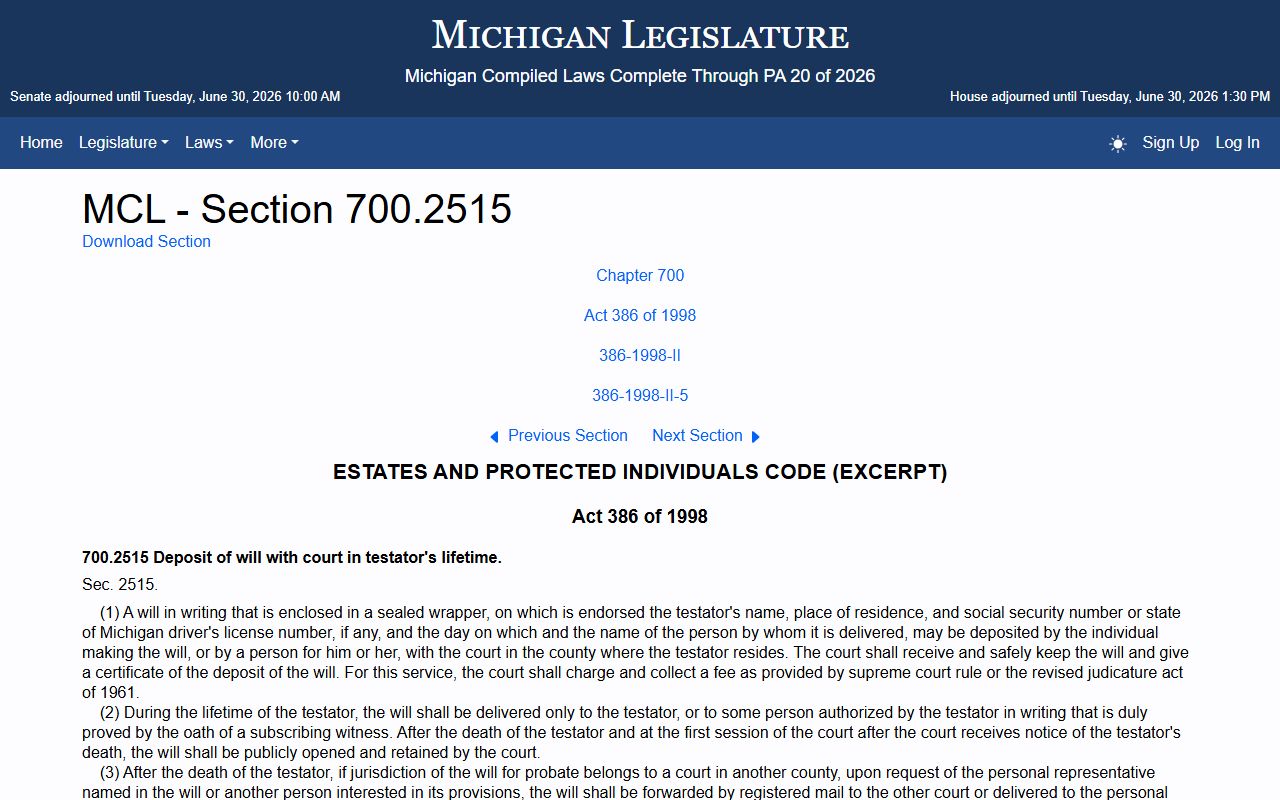
A deposited will is not a public record while the testator is alive. It stays sealed with the court and is opened only under the conditions the statute allows, which is what makes safekeeping a private planning step rather than an early public filing.
What Clinton County Probate Records Show
An open probate file tells the story of an estate from start to finish. Once a case begins, the record can include the will if one exists, the order appointing a personal representative, the inventory listing the estate's assets, and the accountings that track money in and out. It ends with the orders that close the estate and distribute what remains to the heirs.
Guardianship and conservatorship files follow a different arc. They show the petition, any physician or evaluation reports the court relies on, the order appointing a guardian or conservator, and the periodic reports that keep the arrangement under supervision. Because these cases protect a vulnerable person, the file often carries more sensitive detail than an ordinary estate.
Not every field a searcher wants is online. The county did not expose a public probate case-search field inventory in its captured pages, so the complete contents of a file are confirmed at the court rather than assumed from a portal. A statewide MiCOURT entry, when it exists, generally shows case-level basics rather than every document inside the file.
Restricted Probate Records
Probate handles some of the most protected records in the county, and openness gives way to privacy in several categories. Michigan court rules treat court records as open unless a statute, court rule, or court order restricts them, and probate holds more than its share of restricted matters. A file being handled by this court does not guarantee public access to every page.
Adoptions are the clearest example. The Probate Court handles adoptions, and adoption matters are treated as confidential rather than as ordinary public civil records. Juvenile cases are similarly guarded. Under MCL 712A.28, juvenile case records are kept out of general public access, open only to people with a legitimate interest or by court order.
Mental health proceedings carry their own protections. Cases involving persons found to be mentally ill or developmentally disabled are handled with restricted access and current SCAO forms, and personal identifying information is redacted from what the public can see. When a probate file touches any of these areas, expect sealed portions, redactions, or a requirement to show legitimate interest before the court will release the record.