
Clinton County Arrest Records and Court Charges
An arrest record is the account of a person being taken into custody. In Clinton County the arrest is made by the Sheriff's Office or a local police agency, and the booking that follows is handled at the county jail on East Townsend Road in St. Johns. The arrest record notes who made the arrest, when it happened, and the offense the officer suspected. It does not, by itself, settle what a person will be charged with. That decision belongs to the Prosecuting Attorney's Office, led by Tony Spagnuolo. Once the prosecutor reviews the police report and authorizes charges, those charges are filed with the court and become the charge record.
The distinction matters when a person searches. The arrest and booking side lives with the jail and the sheriff, and custody detail such as who is currently held is covered on the Clinton County inmate records page. The court charges after arrest live with the court: the 65A District Court for misdemeanors and felony preliminary steps, and the 29th Judicial Circuit Court for felonies. The charge record tracks each count, its statute code, and its changing status as the case moves. The full case file, including pleas, hearings, and the final outcome, is detailed on the Clinton County criminal court records page.
One local point cuts through a common misunderstanding. A victim cannot drop charges, and police cannot file them. Crimes are reported to police, police forward the matter to the prosecutor, and only the prosecutor can issue or dismiss a charge in Clinton County.
How Charges Get Filed After an Arrest
The arrest is the starting point, not the charge. After booking, the police report goes to the prosecutor, who decides whether the facts support a criminal accusation. If they do, the prosecutor authorizes a charging document, and that document opens the court case. Michigan uses three main charging documents, and the one that applies depends on how serious the offense is and how the case reaches the court. A misdemeanor and a felony travel different paths from that first filing.
Most Clinton County cases begin with a complaint. Felonies then pass through the 65A District Court for a preliminary examination, and if the judge finds probable cause the case is bound over to circuit court, where the prosecutor files an information. A grand jury indictment is rare in Michigan state practice but remains a recognized route for the most serious matters. The table below sets the three side by side.
| Complaint | Information | Indictment | |
|---|---|---|---|
| Filed By | Officer / Prosecutor | Prosecutor | Grand Jury |
| Common For | Misdemeanors | Many felonies | Serious felonies |
| Court | District Court | Circuit Court | Circuit Court |
| Starts | The case | The case in circuit | The case |
Note: The complaint is a sworn document, so the charge listed on it is an accusation the prosecutor believes probable cause supports, not a finding of guilt.
Charge Codes and Severity Levels
Every charge is tied to a statute. Michigan crimes are cited to the Michigan Compiled Laws, and the citation on a charge record points to the exact section the prosecutor says was violated. That code is what tells a reader whether a charge is a felony or a misdemeanor, and it is the anchor for the possible penalty.
Michigan sorts offenses by severity. A felony is punishable by more than one year in prison. A misdemeanor carries up to one year in jail, and many carry a 93-day cap. Civil infractions, which cover most routine traffic matters, are not crimes at all and produce fines rather than a criminal charge. A single arrest can generate several separate charges, because each distinct act or count is charged on its own line. Repeat offenders may also see a habitual-offender notice that raises the possible sentence without adding a new underlying crime.
- Felony: punishable by more than one year, filed in or bound over to circuit court.
- Misdemeanor: up to one year in jail, often capped at 93 days, handled in district court.
- Civil infraction: a fine-only violation, not a criminal charge.
- Habitual-offender notice: a sentence enhancement tied to prior convictions.
Charge Status and What It Means
Charges rarely stay frozen. As a case moves, the prosecutor and the court can change what is on the record. A charge can be amended, reduced, added, dropped, or dismissed, and the case index reflects each change. Reading the status is how a searcher tells a live accusation from one that is already resolved. The terms below appear again and again in Michigan court records.
| Status | What It Means |
|---|---|
| Pending | The charge is filed and the case is still open, with no verdict or plea yet entered. |
| Amended / Reduced | The prosecutor changed the charge, often lowering a felony to a misdemeanor as part of a plea. |
| Bound Over | A district-court judge found probable cause at the preliminary exam and sent the felony to circuit court. |
| Dismissed | The court ended the charge without a trial verdict, either with prejudice or without prejudice. |
| Nolle Prosequi | The prosecutor formally declined to pursue the charge, a Latin phrase meaning unwilling to prosecute. |
A dismissal without prejudice can be refiled later, while a dismissal with prejudice cannot. That single distinction changes what a charge record means for the person named on it.
Charge vs. Conviction
Being charged is not the same as being convicted. A charge is an accusation that only needs probable cause to be filed. A conviction is a finding of guilt, and it requires proof beyond a reasonable doubt through a plea or a trial. A person keeps the presumption of innocence at every stage until that finding is entered. A charge record can therefore show serious counts that never led to a conviction, because they were dismissed, reduced, or resolved without a guilty finding.
| Charge | Conviction | |
|---|---|---|
| Stage | Accusation | Verdict or plea |
| Burden of Proof | Probable cause | Beyond reasonable doubt |
| Decided By | Prosecutor | Judge or jury |
| Public Record | Yes | Yes |
How to Find Clinton County Arrest Records and Charges
Charges and their status show up in the court case index, not the jail log. Two portals hold most of what the public can see. The Clinton County Clerk of Courts record search, known as CaseLook, lets people search filings by name, attorney, agency, judge, and date range. The Michigan statewide MiCOURT case search reaches the 65A District Court through its D65A court path and can return civil, criminal, traffic, domestic, and probate cases depending on the court. Booking and custody detail, by contrast, comes from the jail information line and the inmate records page rather than these court indexes.
- Open the county clerk record search or the statewide MiCOURT case search and accept the data disclaimer.
- Search by the defendant's name, or by case number if it is known, using the name and date fields.
- Open the matching case and read the charge list, which shows each count filed against the defendant.
- Check each charge for its statute code, its level as a felony or misdemeanor, and its current status.
The county clerk portal warns that its data can lag actual filings by at least 24 hours and may change without notice, so a very recent arrest may not show a charge yet. Not every question resolves online, though. For a limited set of matters, the county offers a warrant review tool and a Court Innovations portal for the 65A District Court, where eligible traffic and warrant items can be reviewed without a full in-person appearance. When a portal does not answer the question, the fallback chain is the appropriate court office in person or by mail, the police agency that handled the case, and the statewide criminal-history channel described below.
Federal Charges in the Eastern District of Michigan
Not every charge tied to Clinton County stays in the county courthouse. Federal crimes are charged by the United States Attorney and heard in the U.S. District Court for the Eastern District of Michigan, which covers this county. The federal side maintains its own case index through PACER, entirely separate from the county clerk and MiCOURT systems. The office that files those charges publishes an overview of its territory and role for the public.
The reach of the district is broad, and its about-our-district page lays out the counties and courthouse cities the office serves.
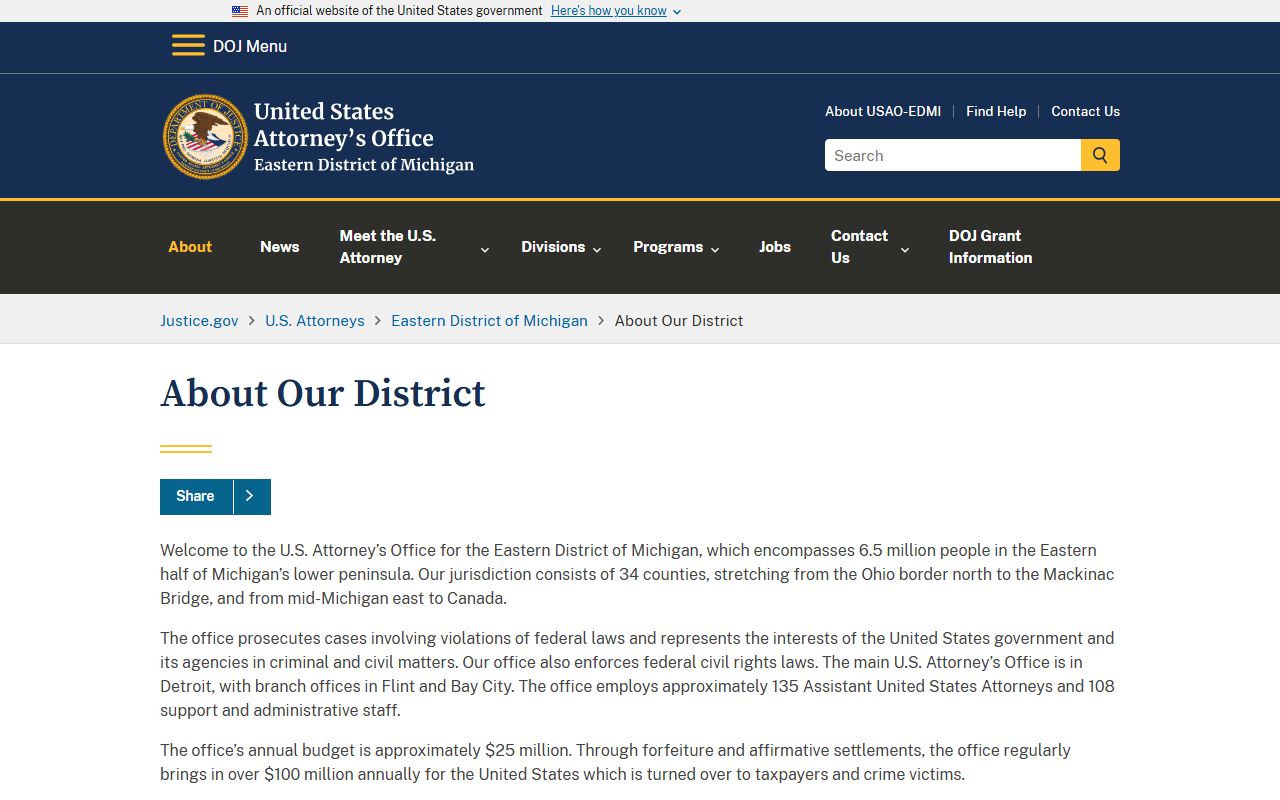
That map helps a reader see why a Clinton County resident charged federally would appear on a Detroit, Flint, or Bay City docket rather than in St. Johns. Federal charges follow the same charge-versus-conviction logic, but they live in a different records system.
The prosecuting office itself, the U.S. Attorney for the Eastern District of Michigan, is the authority that decides which matters become federal charges.
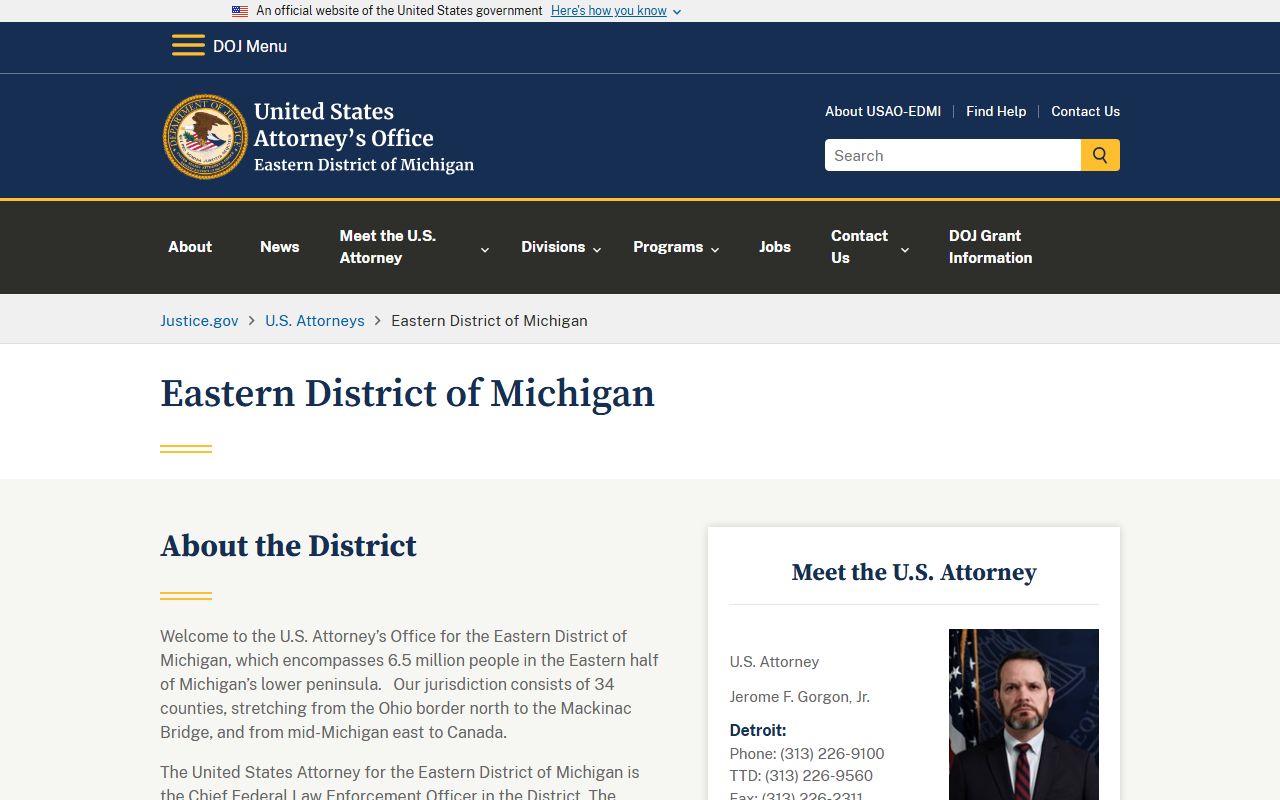
For most local arrests the charge is a state charge, but anyone verifying a record should know the federal track exists and is searched separately through PACER, not through the county portals.
Statewide Charge and Criminal History Lookups
A county case index shows charges filed in that county. A statewide criminal history pulls together charges and convictions from across Michigan. The Michigan State Police is the agency responsible for criminal and juvenile identification records, and its public background service is where a charge in one county rolls up into a broader record. That responsibility is set in statute.
The authority for statewide record keeping sits in MCL 28.241, which directs how the state police maintain criminal and juvenile identification records.
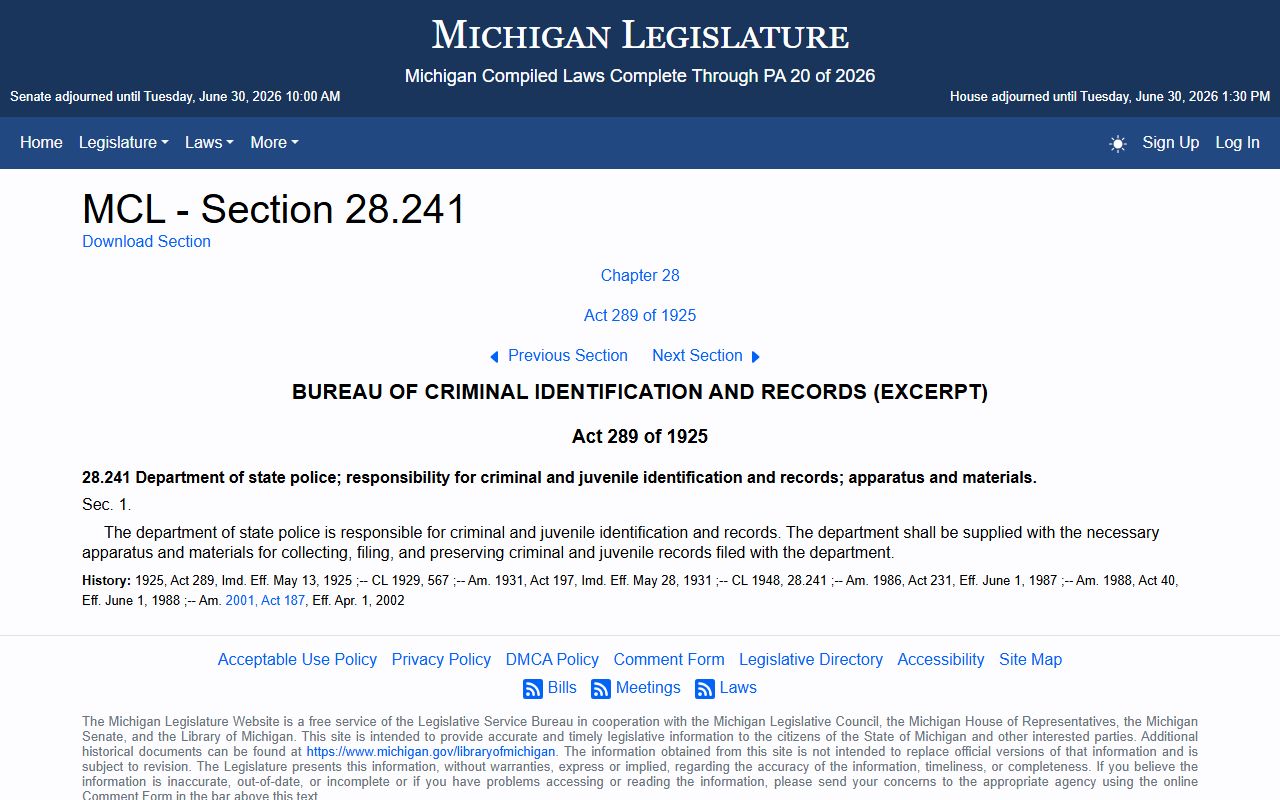
That statute is why a charge filed in St. Johns can eventually surface in a statewide history check rather than only in the local case index. A statewide search is the right tool when a person may have cases in more than one Michigan county, while the Clinton County clerk portal is the right tool for confirming the detail of a specific local charge.
Background Check Considerations
A casual charge lookup and a formal background check are not the same thing. Reading a court index to see the status of a case is public and routine. Using a record to decide employment, housing, credit, or insurance is regulated, and those decisions must run through a screening process that follows the Fair Credit Reporting Act. A raw charge record does not tell the full story on its own, because it may show counts that were later dismissed, reduced, or set aside.
Important: This site is not a consumer reporting agency under the Fair Credit Reporting Act, and its information may not be used for employment, tenant, credit, or insurance screening.
Sealed vs. Expunged Records
Michigan gives people two different ways a charge or conviction can leave public view, and they work differently. A sealed record is hidden from the general public by court order but still exists in the court file. A set-aside, which is Michigan's term for expungement, goes further: the convicting court removes the conviction from public access, and court guidance requires that information about a set-aside conviction be redacted before a record is released. Neither one erases the underlying event for every purpose, and law enforcement retains limited access in both cases.
| Sealed | Expunged / Set Aside | |
|---|---|---|
| Visibility | Hidden from public | Removed from public access and redacted |
| Law Enforcement | Limited access | Very limited access |
| Michigan Rule | By court order under MCR 8.119 | By petition under MCL 780.621 |
| Eligibility | Case-specific, judge decides | Waiting periods and offense limits apply |
The county's own court-services pages list a conviction set-aside tool, a signal that the process is active locally. The convicting court remains the source of record, so a set-aside request is filed there under MCL 780.621.
Restricted Charge Records in Clinton County
Some charge records are not open to a general public search. Michigan restricts several categories, and a searcher who cannot find a case is often looking at a record the law keeps out of view rather than one that does not exist. Juvenile charges are the clearest example. Since January 1, 2021, juvenile case records are closed to the general public and are available only to people with a legitimate interest or by court order, a limit rooted in MCL 712A.28. Set-aside convictions are redacted before release, and adoption and certain mental-health matters in probate court are handled outside the ordinary public docket.
Victim privacy adds another layer. Michigan court materials direct that victim identifying details be withheld or redacted from public case records, so a charge record may appear with names and addresses removed even when the case itself is public.
The Michigan courts publish specific guidance on victim confidentiality and court records that explains how those protections are applied.
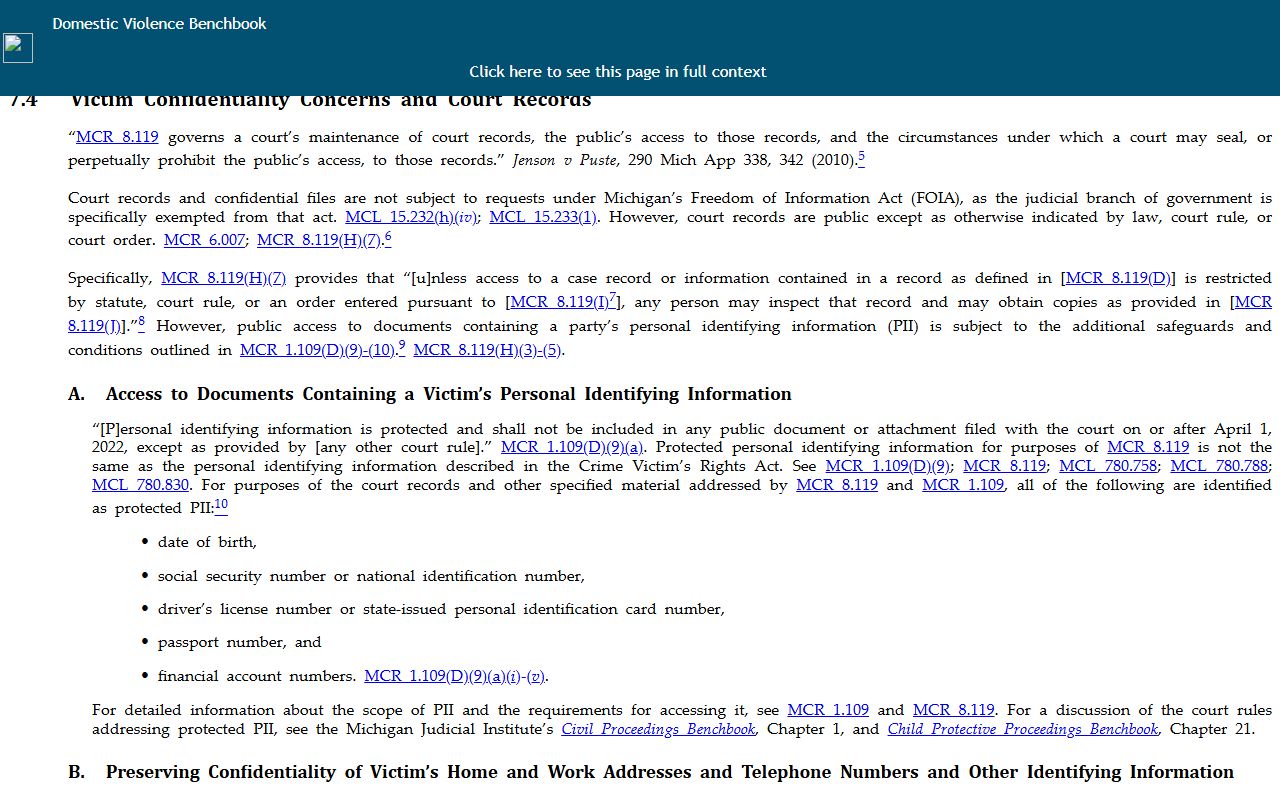
That guidance is why some charge records show redacted fields, and it is a reminder that an open case file is not always a complete one. For the count-by-count charge, the county clerk portal is the source, and for the full outcome the criminal case file at the court holds the final word.