
Criminal Court Records in Clinton County
A Clinton County criminal court record is the official case file the court opens the moment a criminal charge is filed. It is not a police report and it is not a jail booking sheet. It is the court's own chronological account of the case: the charging document, each hearing, every motion and order, the plea or verdict, and the final sentence. The file stays open and grows entry by entry until the case is closed, and it remains a public record afterward unless a statute or court order restricts it.
Two courts hold criminal case files here, and the split follows the seriousness of the offense. The 65A District Court handles adult misdemeanors, ordinance violations, arraignments, bond decisions, misdemeanor trials, sentencing, and the felony preliminary exam. The 29th Judicial Circuit Court, which serves Clinton and Gratiot Counties together, handles felony cases and criminal appeals that come up from the district court. Felony files often begin in the district court and move to the circuit court after a bindover, so a single serious case can leave records in both places. The County Clerk is the filing point for circuit criminal cases.
Because charges themselves get a closer look on the Clinton County arrest and court charge records page, and because every category of court file is mapped on the county court records page, this page stays on the case-level story: what happens to a charge once it reaches a judge.
How a Clinton County Criminal Case Moves
A criminal case is not one event. It is a sequence of court steps, and each step drops a new entry into the record. Knowing the sequence makes the docket far easier to read, because the entries appear in the order the case actually traveled. In Michigan, felonies and misdemeanors start the same way but split apart at the preliminary exam, when a felony either binds over to the circuit court or resolves in the district court.
Charges do not start with the court. Crimes are reported to police, the police forward the matter to the Prosecuting Attorney, and the prosecutor decides whether a charge moves ahead. Only then does a case file open. The stages below follow Michigan's real district-to-circuit path.
Case flow: Charges Filed › Arraignment › Preliminary Exam / Bindover › Pretrial › Plea or Trial › Disposition › Sentencing
| Stage | What Happens and What the Record Shows |
|---|---|
| Charges Filed | The prosecutor authorizes a complaint. The court opens a case file with the charge counts, statute citations, and the assigned court. |
| Arraignment | The defendant's first court appearance. The judge reads the charges, sets or reviews bond, and the defendant may enter an early plea. Court-appointed counsel is requested from the judge here. |
| Preliminary Exam / Bindover | For felonies, the district court tests probable cause. If it holds, the case binds over to the 29th Circuit Court. Misdemeanors stay in district court. |
| Pretrial / Motions | Lawyers file motions, exchange discovery, and discuss resolution. Motions, orders, and continuances are entered on the docket. |
| Plea or Trial | The case resolves by plea or goes to a bench or jury trial. The record shows the plea entered or the verdict returned. |
| Disposition | The formal outcome: guilty, not guilty, dismissed, or diverted. This is the anchor entry background searches look for. |
| Sentencing | The judge orders the penalty: jail, probation, fines, costs, or a treatment program. The sentence and any conditions are recorded. |
Clinton County also runs sentencing alternatives that can appear in a record, including the Mid-Michigan Regional Sobriety Court for drunk and drugged driving cases and the Mid-Michigan Regional Mental Health Court. Both are treatment programs that run 12 to 24 months across four phases and can replace or shorten a traditional sentence.
How to Search Clinton County Criminal Court Records
The right search tool depends on the court level. Felony and circuit criminal files are searched through the County Clerk's circuit-court record search and the statewide case system. Misdemeanor and district-court matters are searched through the district court case inquiry and the county's online review tools. Starting at the correct court level, rather than a single generic county search, is how the county itself tells people to begin.
- Decide the court level: misdemeanor or district matter, or felony or circuit matter. This picks the portal.
- For circuit felonies, open the Clinton County record searches page and the clerk's court record search tool, which searches by name, attorney, judge, or date.
- For district cases, use the district court case inquiry and its register-of-actions links.
- Search by defendant name or case number, then narrow by case type and filing date to reach the right file.
- Open the case to read the docket, disposition, and sentence, and request a certified copy from the County Clerk if a court-usable copy is needed.
The statewide layer is MiCOURT case search, which can return civil, traffic, criminal, domestic, and probate cases depending on the court, with a direct link to the 65A District Court. The county also runs an online review path for traffic and warrant matters. The Online Warrant Review tool lets people check eligible tickets and warrant status by date of birth, driver's license, and case number.
The Clinton County Online Warrant Review page below is the county's clearest self-service door into the district court's traffic and warrant matters. The county's Online Warrant Review page explains what the Court Innovations tool reviews and what data it needs.
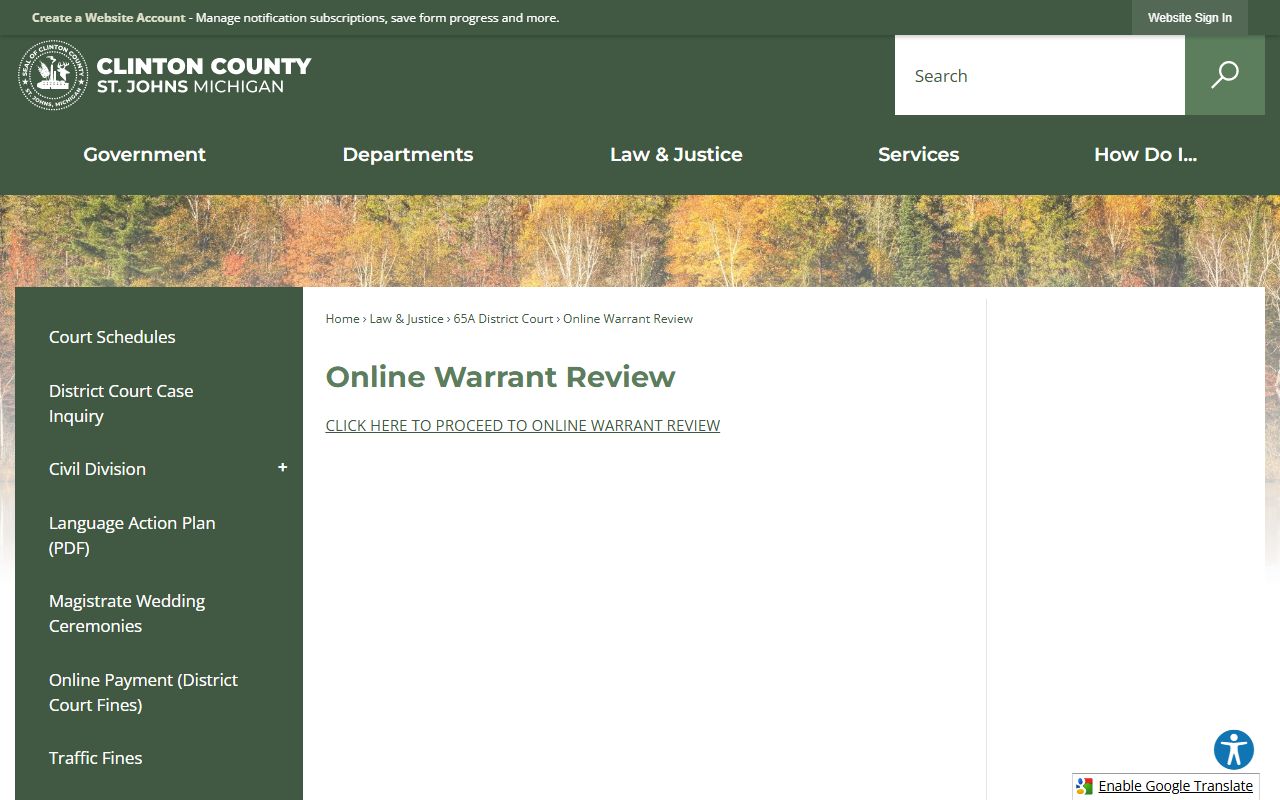
Because the tool routes eligible traffic and warrant cases to a real judge and officer for review, it is a practical first stop before a criminal matter is fully calendared for a hearing.
Records that predate July 1996 or that were never digitized are handled at the counter. For circuit files, the clerk offers in-office searches at no fee for pre-July-1996 records, or a mail search for $10 per name covering a 10-year window, completed within 24 hours. In-person and mail requests remain the fallback for any file the online tools do not surface.
What a Clinton County Criminal Court Record Shows
A criminal case file is built from standard fields, whether it sits in the district or circuit court. Reading them in order tells the whole story of a case, from the accusation through the penalty. The table below walks through the fields a searcher will meet most often on a Michigan criminal record.
| Field | What It Shows |
|---|---|
| Case Number | The court's unique identifier for the file, used by the clerk portal and MiCOURT to pull the record. |
| Court | Whether the case sits in the 65A District Court or the 29th Circuit Court, which signals misdemeanor versus felony. |
| Defendant | The person charged, listed by name, with the attorney of record where one is appointed or retained. |
| Charges | The counts as filed, with statute citations and severity level. Charges may be amended, reduced, or dropped as the case moves. |
| Filing Date | When the complaint was filed and the case opened, which starts the docket timeline. |
| Docket Entries | The chronological register of actions: motions, orders, hearing dates, and continuances. |
| Plea | The defendant's formal response to the charges, such as guilty, not guilty, or no contest. |
| Disposition | How the court resolved the matter: conviction, acquittal, dismissal, or diversion. |
| Sentence | The penalty ordered, including jail, probation, fines, costs, and any program conditions. |
| Status | Values such as open, closed, disposed, transferred, sealed, or nonpublic. |
Michigan court rules and benchbook guidance direct courts to withhold or redact personal identifying information, so a public criminal file will not show full Social Security numbers, financial-account details, or other protected identifiers.
Charges vs. Convictions
A charge is an accusation. A conviction is a proven result. A criminal court record can list charges that were later dropped, dismissed, or that ended in acquittal, and reading a file without that distinction is the most common mistake people make. In Clinton County, the Prosecuting Attorney decides what charges to file and whether to dismiss them. A crime victim cannot drop charges, because the charging decision belongs to the prosecutor, not to the person harmed.
The Clinton County Prosecuting Attorney's Office page below sets out how charging works, from the report to police through the decision to prosecute. The prosecutor's office page confirms that crimes are reported to police, not the prosecutor, and that only the prosecutor can issue or dismiss charges.
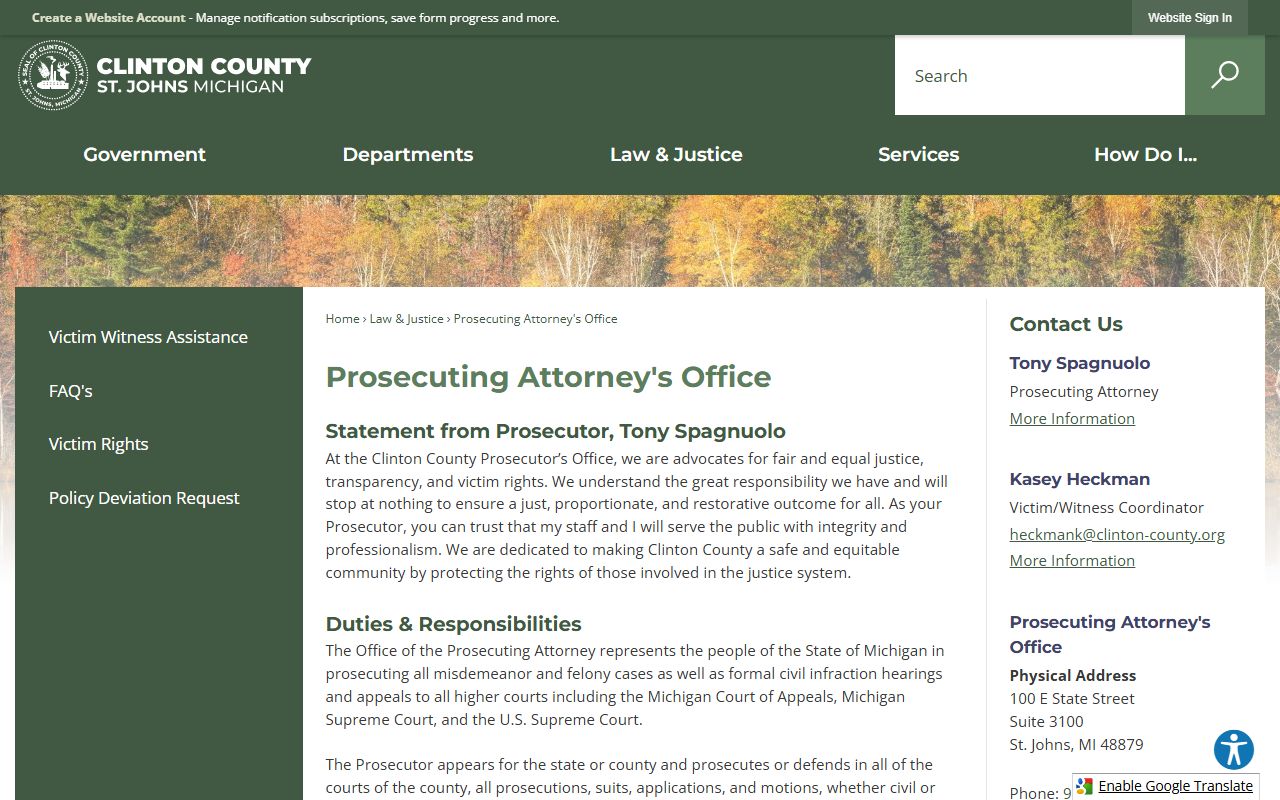
That routing explains why a file can show serious counts that never became convictions: the prosecutor filed them, but the case resolved another way.
| Charge | Conviction | |
|---|---|---|
| Stage | Accusation filed by the prosecutor | Verdict or plea entered by the court |
| Burden of Proof | Probable cause | Beyond a reasonable doubt |
| Who Decides | Prosecuting Attorney | Judge or jury |
| Public Record | Yes | Yes |
Note: A charge on a Clinton County record is not proof of guilt, so always read through to the disposition line before drawing any conclusion about the case.
Reading Dispositions and Sentences
The disposition is the outcome line, and it is the field most background searches are really after. Common values include guilty, not guilty, dismissed, and no contest, which Michigan calls nolo contendere. A case may also be diverted into a treatment program instead of a straight conviction. When a case is dismissed, the record often notes whether it was dismissed with prejudice, meaning it cannot be refiled, or without prejudice, meaning it can.
The sentence follows a conviction and sets the penalty. It can combine jail time, probation, fines, court costs, restitution, and program conditions. Probation is a supervised sentence served in the community rather than in custody. For jail custody status tied to a sentence, the Clinton County jail roster tracks who is currently held. Reading the disposition and sentence together tells you both what the court found and what it ordered.
Public Access to Criminal Court Records
Michigan court records are open by default. They are not obtained through a normal Freedom of Information Act request, because the judicial branch is exempt from Michigan's FOIA and court files are governed by court rule instead. The controlling rule, MCR 8.119, makes court records open unless a statute, court rule, or court order restricts them, and it requires public electronic documents to be available to the same extent as the paper file at the courthouse.
The Michigan courts' guidance on access to court records and proceedings, shown below, lays out how the openness rule and its privacy limits fit together. The state benchbook chapter on access to court records is the reference courts use to decide what is public and what is protected.
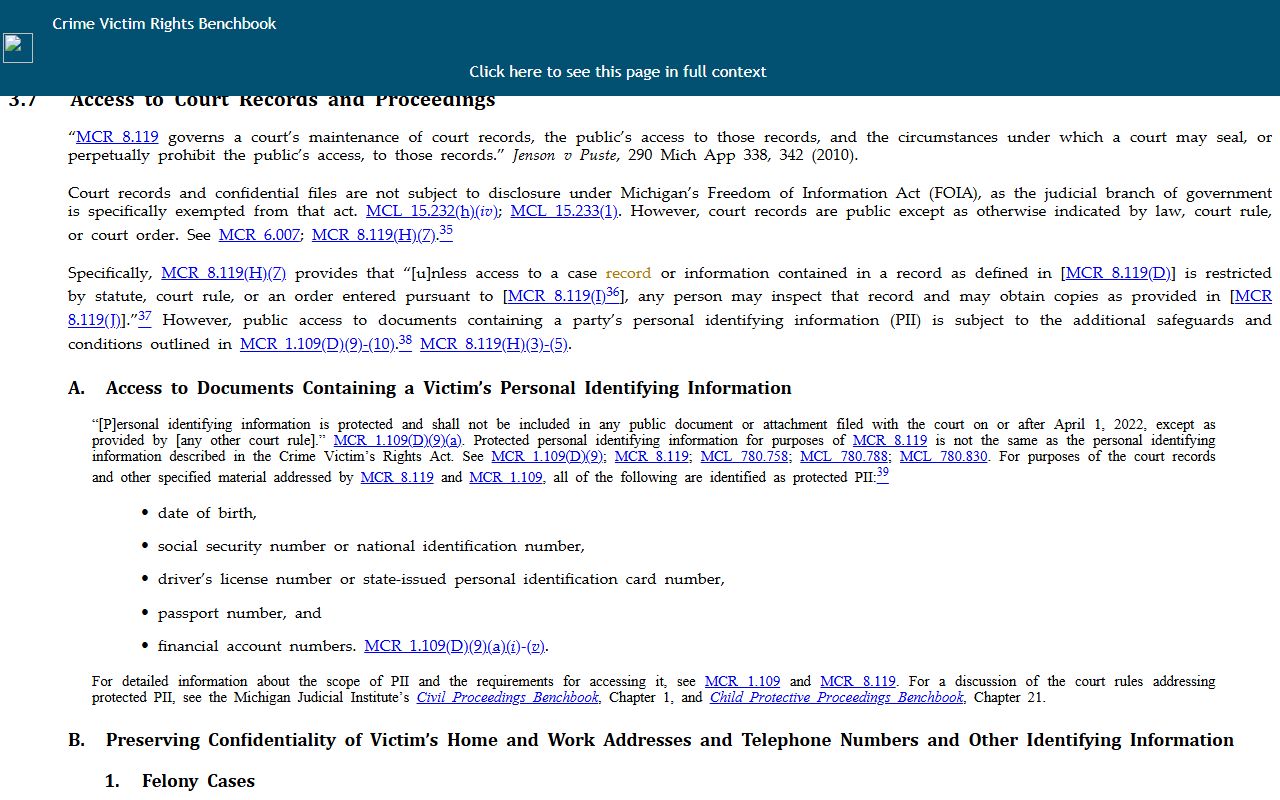
The practical takeaway is that the court, not FOIA, is the source of a criminal record, and the same rules apply whether the file is paper or electronic.
Key Statutes:
Michigan Court Rule 8.119 - Court records are open to the public unless restricted by statute, rule, or order, with electronic access matching courthouse access.
Michigan FOIA, Act 442 of 1976 - Governs public bodies but exempts the judiciary, so court records fall under court rules rather than FOIA.
MCL 28.241 - Makes the Michigan State Police responsible for criminal and juvenile identification records, which is where a court case can feed a statewide criminal-history file.
Where to Access Clinton County Criminal Records
A single portal rarely holds every record, so it helps to know the full set of channels. County online tools cover recent circuit and district cases, MiCOURT adds a statewide layer, and the clerk's counter fills the gaps for older or paper-only files. Federal crimes are a separate system entirely.
- County online: the clerk's court record search for circuit files and the district court case inquiry for misdemeanor and traffic matters.
- Statewide: MiCOURT case search across participating Michigan courts.
- In person and by mail: the County Clerk's office for certified copies and pre-July-1996 files.
- Federal: the U.S. District Court for the Eastern District of Michigan through PACER and CM/ECF for federal crimes.
- Free research layer: CourtListener for many federal dockets and opinions.
Federal crimes charged against Clinton County residents are handled by the U.S. District Court for the Eastern District of Michigan, not by the county courts. Those dockets are viewed through the court's PACER and CM/ECF login, which requires a registered account, and the court's own Eastern District of Michigan site explains how to register and file.
A free alternative for federal research is CourtListener, shown below, which hosts many federal dockets and opinions without a PACER fee. CourtListener is a useful starting point, but it is a research layer, not the official court record.
For any decision that matters, verify the case against the originating court's own file rather than relying on a third-party copy.
Sealed vs. Set Aside and Expunged
Michigan does not use the word "expungement" in its main statute. It uses "set aside." Under MCL 780.621, an eligible person can ask the convicting court to set aside a qualifying conviction. A set-aside conviction is not erased from existence, but the public-facing record is restricted, and Michigan court guidance requires the information relating to a set-aside conviction to be redacted before the file is made public. Sealing, by contrast, hides a record or a document from general public view by court order while the file still exists.
The Michigan set-aside statute below spells out who qualifies and how the process works, and Clinton County runs a Conviction Set Aside path among its online court tools. MCL 780.621 is the statute a person files under to ask the court to set aside a conviction.
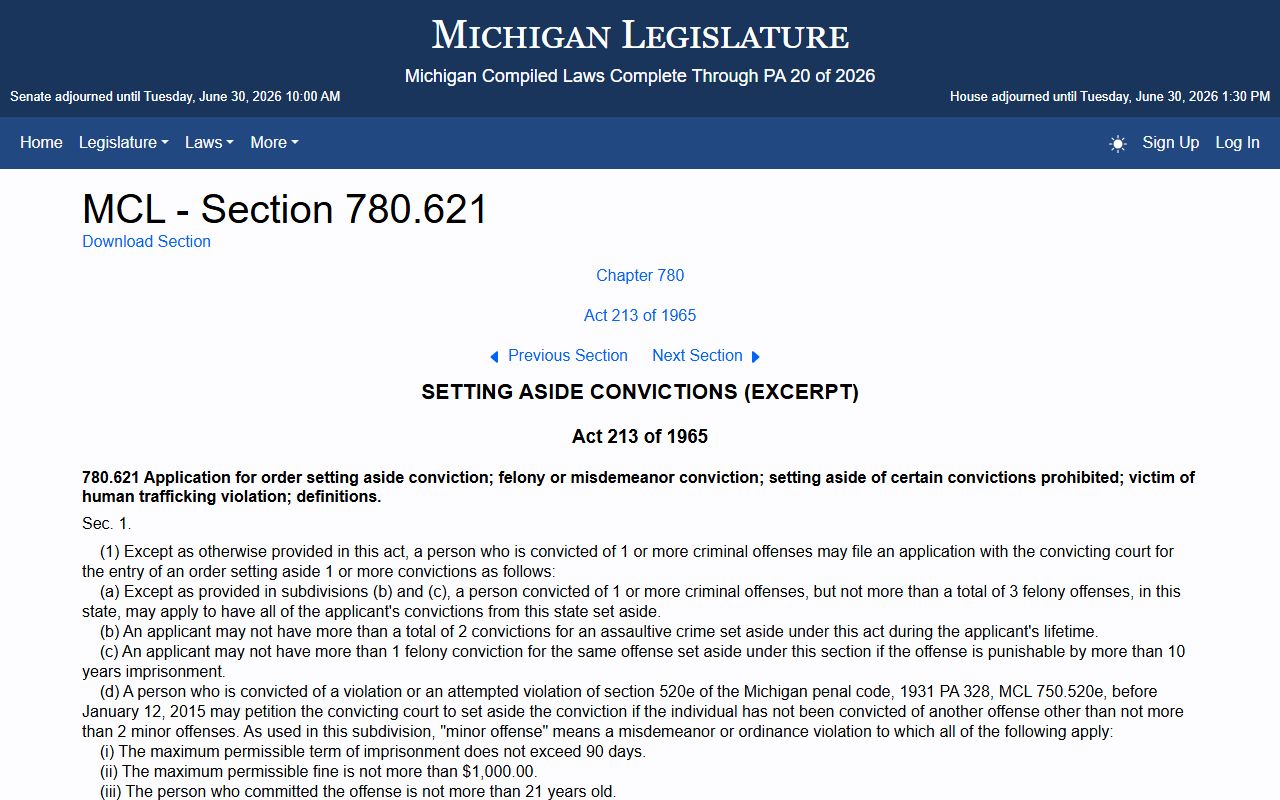
Because the request is filed in the court that entered the conviction, the county court, not a private service, remains the source of record for any set-aside.
| Sealed | Set Aside / Expunged | |
|---|---|---|
| Visibility | Hidden from public view by court order | Public record restricted and redacted, not destroyed |
| Law Enforcement | Limited access | Retained for defined legal uses |
| Michigan Basis | Court rule or court order | Set-aside statute, MCL 780.621 |
| Where Filed | The court holding the record | The convicting court |
Restricted Criminal Court Records in Clinton County
Not every criminal-related file is open. Juvenile cases are the clearest example. Michigan law restricts juvenile case records, and beginning January 1, 2021, they are no longer open to the general public. Access is limited to people with a legitimate interest, which includes the juvenile, a parent or guardian, counsel, law enforcement, the prosecutor, and certain agencies, or by court order.
The juvenile confidentiality statute below is the authority for that closure, and it explains who still has access after the 2021 change. MCL 712A.28 is the section that keeps juvenile case records out of general public access.
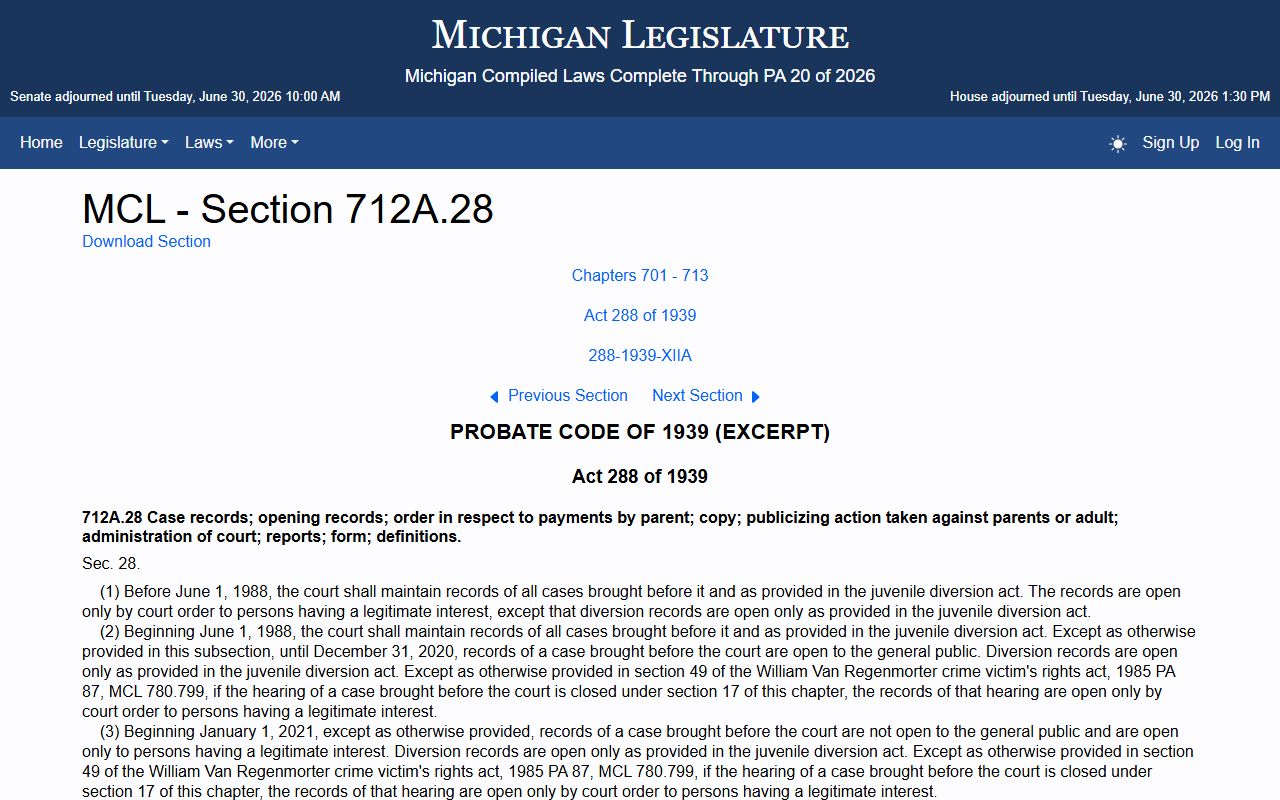
Along with juvenile files, set-aside convictions are redacted, sealed matters are withheld, and ongoing cases may have documents that are not yet public.
Beyond juvenile matters, several other categories are limited. Adoptions and certain mental-health proceedings are handled by the Probate Court and are not treated like ordinary public civil files. A state criminal-history record built from court dispositions is maintained by the Michigan State Police under MCL 28.241 and is governed by its own dissemination rules, separate from the open court file. For active-warrant status behind an unresolved charge, the county routes questions to the police agency handling the case, and Clinton County warrant records cover that path separately.
Important: This site is a privately operated resource, not an FCRA-regulated consumer reporting agency, and its records may not be used for credit, employment, tenant, or insurance screening.